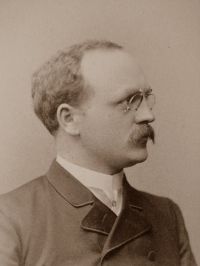
Carl Pulfrich

Carl Pulfrich

Summary

Portrait of Carl Pulfrich Carl Pulfrich 1911 Encyclopædia Britannica (1911)

In both kinds of stereo- scopic vision the exactness of the observation of the depth is greater as the point J approaches H, and the point H approaches P. As a matter of fact a man's eyes are naturally never perfectly still. They move in their sockets, and the point P, where the axes intersect, is continually changing. Direct stereoscopic vision arises from indirect stereoscopic vision and vice versa, and the accuracy of the discernment of the depth increases and decreases.
Source: Wikisource

Portrait of Carl Pulfrich Carl Pulfrich 1911 Encyclopædia Britannica (1911)

This, however, cannot be regarded as an actual perception of depth, because these viewings necessitate a consideration for each individual interpretation, which is quite foreign to stereoscopic vision.
Indirect stereoscopic vision is of great importance. It makes it possible to recognize any sudden danger or obstacle outside the direction in which one is looking. Even with the stereo- telemeter (see below) the position of the range through which, for example, a bird flies, could not always be accurately given, if one were solely dependent upon direct stereoscopic vision.
Source: Wikisource

Portrait of Carl Pulfrich Carl Pulfrich 1911 Encyclopædia Britannica (1911)

In man this spot is still near the axis, although not always exactly on it. It is not perfectly known how it is situated in animals, but in many the axes of the eyes diverge (especially strongly in geese) , and the portions of the retina utilized in stereoscopic vision lie far distant from the axis, as in many animals the eyes are only slightly movable.
Source: Wikisource

Get perspective with Kwize: daily news enlightened by great literature