Summary

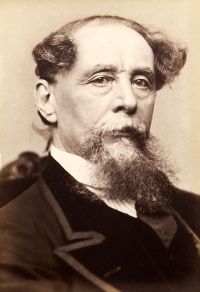
Portrait of Charles Dickens Charles Dickens The Posthumous Papers of the Pickwick Club (1837)

Payne gazed with a ferocious aspect on the beaming countenance of the unconscious Pickwick.
"Sir," said the Doctor, suddenly addressing Mr. Tupman, in a tone which made that gentleman start as perceptibly as if a pin had been cunningly inserted in the calf of his leg—"you were at the ball here, last night?"
Mr. Tupman gasped a faint affirmative; looking very hard at Mr. Pickwick all the while.
"That person was your companion," said the Doctor, pointing to the still unmoved stranger.
Source: Wikisource

Portrait of Charles Dickens Charles Dickens The Posthumous Papers of the Pickwick Club (1837)

Snodgrass was about to offer an historical account of the circumstances just now detailed, when he was suddenly checked by observing that there were present, not only Mr. Tupman and their stage-coach companion of the preceding day, but another stranger of equally singular appearance. It was a careworn-looking man, whose sallow face, and deeply-sunken eyes, were rendered still more striking than nature had made them, by the straight black hair which hung in matted disorder half way down his face.
Source: Wikisource

Portrait of Charles Dickens Charles Dickens The Posthumous Papers of the Pickwick Club (1837)

Pickwick had leisure to examine his costume and appearance.
He was about the middle height, but the thinness of his body, and the length of his legs, gave him the appearance of being much taller. The green coat had been a smart dress garment in the days of swallow-tails, but had evidently in those times adorned a much shorter man than the stranger, for the soiled and faded sleeves scarcely reached to his wrists.
Source: Wikisource

Get perspective with Kwize: daily news enlightened by great literature