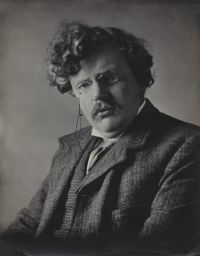
Gilbert Keith Chesterton

Gilbert Keith Chesterton

Summary

Portrait of Gilbert Keith Chesterton Gilbert Keith Chesterton Charles Dickens — IV: "The Pickwick Papers" (1906)

Dickens has caught, in a manner at once wild and convincing, this queer innocence of the afternoon of life. The round, moonlike face, the round, moon-like spectacles of Samuel Pickwick move through the tale as emblems of a certain spherical simplicity. They are fixed in that grave surprise that may be seen in babies; that grave surprise which is the only real happiness that is possible to man. Pickwick's round face is like a round and honourable mirror, in which are reflected all the fantasies of earthly existence; for surprise is, strictly speaking, the only kind of reflection.
Source: Wikisource

Portrait of Gilbert Keith Chesterton Gilbert Keith Chesterton Charles Dickens — IV: "The Pickwick Papers" (1906)

When a modern novel is devoted to the bewilderments of a weak young clerk who cannot decide which woman he wants to marry, or which new religion he believes in, we still give this knock-kneed cad the name of "the hero" -- the name which is the crown of Achilles. The popular preference for a story with "a happy ending" is not, or at least was not, a mere sweet-stuff optimism; it is the remains of the old idea of the triumph of the dragon-slayer, the ultimate apotheosis of the man beloved of heaven.
Source: Wikisource

Portrait of Gilbert Keith Chesterton Gilbert Keith Chesterton Charles Dickens — IV: "The Pickwick Papers" (1906)

It is a certain air of endlessness in the episodes, even in the shortest episodes -- a sense that, although we leave them, they still go on. Our modern attraction to short stories is not an accident of form; it is the sign of a real sense of fleetingness and fragility; it means that existence is only an impression, and, perhaps, only an illusion. A short story of to-day has the air of a dream; it has the irrevocable beauty of a falsehood; we get a glimpse of grey streets of London or red plains of India, as in an opium vision; we see people -- arresting people with fiery and appealing faces.
Source: Wikisource

Get perspective with Kwize: daily news enlightened by great literature