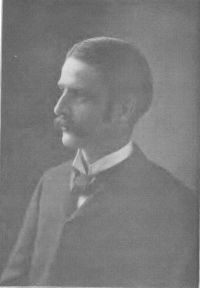
Charles Emerson Beecher

Charles Emerson Beecher

Summary

Portrait of Charles Emerson Beecher Charles Emerson Beecher Second Geological Survey of Pennsylvania… (1884)

The tubercle, as indicated above, is one of the most constant features of the carapace in all of the species and must have a special significance. In a number of specimens examined, by the writer, under the microscope a subcircular depression is observed at or near the summit of this tubercle as in the ocelli of Eurypterus, etc. The fact that facets cannot be discerned is no criterion of their absence in the animal, for numerous trilobites and Eurypterus have as yet revealed no evidence of the compound character of their eyes, and on the other hand many species have large and distinct facets.
Source: Wikisource

Portrait of Charles Emerson Beecher Charles Emerson Beecher Second Geological Survey of Pennsylvania… (1884)

Abdomen tapering towards the posterior end, composed of six exposed segments, having a total length of one-fourth greater than the length of the carapace. The segments increase in length towards the posterior segment, which has a length equal to two of the anterior segments, and is twice as long as wide; while the anterior somites have a greater width than length. The anterior dorsal margin of each is thickened and arched backwards; the posterior margin is furnished with from four to six strong spines, which project over the articulation of the succeeding segment.
Source: Wikisource

Portrait of Charles Emerson Beecher Charles Emerson Beecher Second Geological Survey of Pennsylvania… (1884)

The thoracic portion of the valve is ornamented with an elongate tubercle near the middle of the anterior portion, produced into a nodose ridge following the contour of the lower margin and dying out before reaching the posterior end. A similar tubercle, but situated transversely, is found in the upper dorsal portion, and is continued in a nodose ridge adjacent to the dorsal line, and along the posterior margin of the valve. In the center of the area partially enclosed by these two ridges is a less prominent longitudinal row of minute nodes forming a third carina.
Source: Wikisource

Get perspective with Kwize: daily news enlightened by great literature