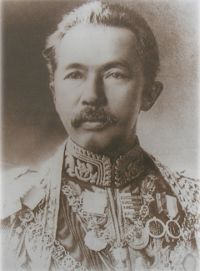
Damrong Rajanubhab

Damrong Rajanubhab

Summary

Portrait of Damrong Rajanubhab Damrong Rajanubhab,  Siamese Musical Instruments (1931)

“ In the mode 'Banleng Pin' only the 'gourd-lute' was used and the singer accompanied himself on it (see plate IX) . Few players can perform on the instrument now and it is not much used, being replaced by the 'Saw' (fiddle) .
The 'Khap Mai' is played by three musicians: a singer, a three-string-fiddle-player who accompanies the singing, and a player of 'Bandoh' drum who marks time (see plate X) . This kind of music obtains nowadays only in certain royal ceremonies, such as those which mark the Coronation anniversaries. The 'Banleng Pin' and the 'Khap Mai' are played exclusively by men.
”
Source: Wikisource

Portrait of Damrong Rajanubhab Damrong Rajanubhab,  Siamese Musical Instruments (1931)

“ To-day it is still popular in the eastern provinces. The 'Pī Saw' and reed organ players separate themselves into two groups, men on one side and women on the other, and they sing love songs in duet. During the reign of King Chulalongkorn, the 1st Guard Infantry Regiment introduced the use of ten reed organs of varying sizes in unison like the instruments of European orchestra. The effect was found pleasing, and the orchestra of reed organs therefore continues to be played even to-day. ”
Source: Wikisource

Portrait of Damrong Rajanubhab Damrong Rajanubhab,  Siamese Musical Instruments (1931)

“ Those which are made of wood, such as castanets for instance, are also to be classed under the group 'Ghana', because they too mark time (see plate III) . It seems that several instruments which play the melody are developed from those used for marking time. For instance, the 'Khong Vong', or a set of gongs, seems to have been evolved from a single gong: first the single gong became a pair of gongs of different notes called 'Khong Khū' (which figures in the Norā orchestra) ”
Source: Wikisource

Get perspective with Kwize: daily news enlightened by great literature