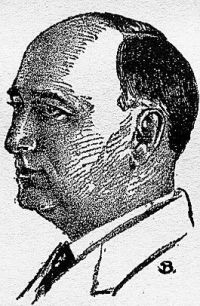
David Henry Keller

David Henry Keller

The Worm (1929)

Summary

Portrait of David Henry Keller David Henry Keller,  The Worm (1929)

“ As soon as Staples reached the first floor, he felt the vibration. Not only could he feel the vibration, he could see it. It seemed that the center of the floor was being pushed up. Flashlight in hand, he opened the cellar door. There was no water there now — in fact there was no cellar left! In front of him was a black wall on which the light played in undulating waves. It was a wall and it was moving. He touched it with the end of his rifle. It was hard and yet there was a give to it. Feeling the rock, he could feel it move. Was it alive? Could there be a living rock? ”
Source: Wikisource

Portrait of David Henry Keller David Henry Keller,  The Worm (1929)

“ A worm like a night crawler, only much larger, in fact, very much larger. That made him laugh — to think how much larger this worm was than the ones he had used for fishing. All through the night he walked the floor and burned the lamp and said, "This is my home. No worm can make me leave it!" Several times he went down the steps, just a few of them, and shouted the message into the pit as though he wanted the Worm to hear and understand, "This is my home! NO WORM CAN MAKE ME LEAVE IT!!" ”
Source: Wikisource

Portrait of David Henry Keller David Henry Keller,  The Worm (1929)

“ He assured the dog that if business ever did come to the mill, he would be ready for it.
It was on Christmas Day of that winter that he first heard the noise. Going down to the basement to see that nothing had been injured by the bitter freeze of the night before, his attention was attracted, even while descending the stone steps, by a peculiar grinding noise, that seemed to come from out of the ground. His ancestors, building for permanency, had not only put in solid foundations, but had paved the entire basement with slate flagstones three feet wide and as many inches thick.
”
Source: Wikisource

Get perspective with Kwize: daily news enlightened by great literature