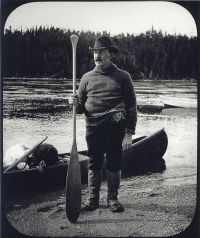
Dillon Wallace

Dillon Wallace

Summary

Portrait of Dillon Wallace Dillon Wallace,  Packing and Portaging

“ One should never start upon a journey with an animal that is lame or has cinch sores or galled back.
When mountain trails are to be negotiated a saddle horse weighing from nine hundred to a thousand pounds will be found better adapted to the work than a larger animal. Too large a horse is liable to be clumsy on the trail, while too light a horse will of course tire under a heavy rider. A small horse, as a rule, is better able to forage a living than a large horse, and [Pg 54] for this reason stands up better with a moderate load on long, continuous journeys.
”
Source: Gutenberg

Portrait of Dillon Wallace Dillon Wallace,  Packing and Portaging

“ It is more than aggravating to find upon arising in the morning that your horse has disappeared and one always feels that time consumed in searching for a roving horse is time worse than wasted. Of course this tendency of an animal can be forestalled by picketing him, but a picketed horse unless forage be particularly good will not do well, for it rarely happens in these days of sheep-ravaged ranges that an animal can find sufficient food to meet his requirements within the limited length of a picket rope. ”
Source: Gutenberg

Portrait of Dillon Wallace Dillon Wallace,  Packing and Portaging

“ In a strong breeze it is often difficult for one man to handle a canoe, for the wind striking it on the side will turn the portager around and he will find it impossible to keep his course in spite of his best efforts. If the portage is a short one—two or three hundred yards—the canoe may be carried very well, one man with the bow the other with the stern upon a shoulder, the canoe on its side with the bottom next the portagers' heads, that they may easily grasp the gunwale in one hand and steady the canoe with the other. ”
Source: Gutenberg

Get perspective with Kwize: daily news enlightened by great literature