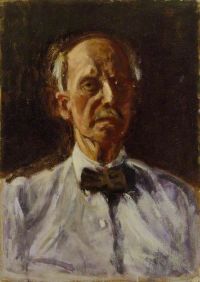
Dugald Sutherland MacColl

Dugald Sutherland MacColl

Summary

Portrait of Dugald Sutherland MacColl Dugald Sutherland MacColl 1911 Encyclopædia Britannica (1911)

Blurred definition, then, as it exists in our natural view of things, is admitted into painting; a blurring that may arise from distance, from vapour or smoke, from brilliant light, from obscurity, or simply from the nearness in value of adjacent objects. Similarly, much detail that in primitive art is elaborated is absorbed by rendering the aspect instead of the facts known to make up that aspect. Thus hair and fur, the texture of stuffs, the blades of grass at a little distance, become patches of tone showing only their larger constructive markings.
Source: Wikisource

Portrait of Dugald Sutherland MacColl Dugald Sutherland MacColl 1911 Encyclopædia Britannica (1911)

If the painter were a scientific reporter he would have to pursue the systems of planes, with their shapes and values, to infinity. Impressionism is the art that surveys the field and determines which of the shapes and tones are of chief importance to the interested eye, enforces these, and sacrifices the rest. Construction, the logic of the object rendered, determines partly this action of the eye, and also decoration, the effects of rhythm in line and harmony in fields of colour.
Source: Wikisource

Portrait of Dugald Sutherland MacColl Dugald Sutherland MacColl 1911 Encyclopædia Britannica (1911)

In any case the result is that minor planes are swamped in bigger, that smaller patches of colour are swept up into broader, that markings are blurred. The final result of these tentative reviews records, in what is blurred and what is clear, the attention that has been distributed to different parts, and to parts measured against the whole. The Impressionist painter does not allot so much detail to a face in a full-length portrait as to a head alone, nor to twenty figures on a canvas as to one.
Source: Wikisource

Get perspective with Kwize: daily news enlightened by great literature