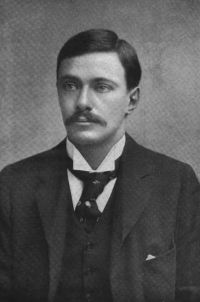
E. F. Benson

E. F. Benson

Corstophine (1925)

Summary

Portrait of E. F. Benson E. F. Benson,  Corstophine (1925)

“ There, on the right of the station yard, were the allotment gardens, and behind them rose the line of moors, among which, no doubt, Helyat lay. There, to the left, were the roofs of sheds, with tall chimneys vomiting smoke, and there in front of me was the mean, steep street stretching into an endless perspective. But to-day, instead of finding a dead and uninhabited town, it was full of busy crowds hurrying about. Children were playing in the gutters; cats sat and made their toilets on doorsteps; the sparrows pecked at the refuse heaps that strewed the road. ”
Source: Wikisource

Portrait of E. F. Benson E. F. Benson,  Corstophine (1925)

“ When we get out of time, when we die, in fact—we shall regard time as just a point, visible all round, so to speak. Some people, even now, get glimpses of it in entirety. We call them clairvoyants. They have visions of the future which are actually and literally fulfilled; or perhaps, when they see such things, they have some revelation of the past which enables them, like the man predicting the sinking of the Titanic, to foretell the future. ”
Source: Wikisource

Portrait of E. F. Benson E. F. Benson,  Corstophine (1925)

“ Our knowledge of what is past makes us able to see into the future. In fact, we shouldn't call it prophecy at all if we were told the sun would rise to-morrow. In just the same way, if a man had known the exact movement of a certain iceberg, and the exact course of the Titanic, he would have been able to predict that the Titanic would founder on that iceberg at a certain moment. Our knowledge of the future, in a word, depends entirely on our knowledge of the past, and if we knew absolutely all about the past, we should know absolutely all about the future. ”
Source: Wikisource

Get perspective with Kwize: daily news enlightened by great literature