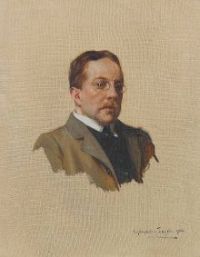
E. W. Hornung

E. W. Hornung

Summary

Portrait of E. W. Hornung E. W. Hornung The Shadow of a Man

It may be that Moya saw both bush and bushman in the same rosy light. To the impartial eye Rigden was merely the brick-red, blue-eyed type of Anglo-Saxon: a transparent character, clean of body and mind, modest but independent, easy-going in most things, immovable in others. But he had been immovable about Moya, whose family at its worst had failed to frighten or to drive him back one inch. She could have loved him for that alone; as it was it settled her; for Moya was of age, and the family had forthwith to make the best of her betrothal.
Source: Gutenberg

Portrait of E. W. Hornung E. W. Hornung The Shadow of a Man

I was with Pelham all the time."
She would never marry him, never! That was no reason why she should give him away. She would never marry a man with discreditable secrets which she might not share, not because they were discreditable, but for the other reason. Yet she must be a humbug for his sake! Moya felt a well-known eye upon her, felt her face bathed in fire; luckily her explanation itself might account for that, and she had the wit to see this in time.
"I mean," she stammered, "one was on the verandah all the afternoon. Nobody could have come without our seeing them."
Source: Gutenberg

Portrait of E. W. Hornung E. W. Hornung The Shadow of a Man

He had managed to drift back to Moya's side, to ensure her complete appreciation of a manoeuvre he delighted in, but at the word of command he was gone without a glance, and visible responsibility settled on his rigid shoulders.
Real dogs kept the mob together, but the head stood stubborn at the gate, with none to lead the way till Rigden touched the foremost fleece with his toe and the race began. Slowly and singly at the start, as the first grains slip through the hour-glass; by wondering twos and threes, as the reluctant leaders were seen alive and well in the farther paddock
Source: Gutenberg

Get perspective with Kwize: daily news enlightened by great literature