“ The rector wore no vestments in the naked eye of heaven, but only his cassock, his surplice, and his Oxford hood. There were flowers upon the simple table behind him, such roses as still grew wild in his tangled garden, but no candle to melt double in the sun. The lectern he had done his best to burnish; but it was still a cripple from the fire. Above, the rector's hair shone like silver, for the sun swept over it, but the lean dark face was all in shadow. Gwynneth only saw the fresh trim cut of the grizzled beard, and the walnut colour of the gnarled hand drooping over the book. ”
E. W. Hornung
Biographical details

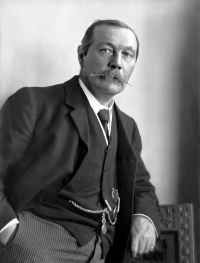
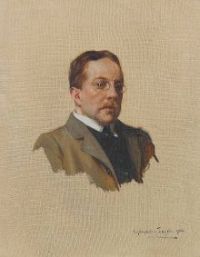
Ernest William Hornung (1866–1921), a British author best known for his A. J. Raffles series, created stories about a dashing gentleman thief navigating late 19th-century London. Drawing from his time in Australia and the Sherlock Holmes tales of his brother-in-law, Arthur Conan Doyle, his work delves into themes of crime, class, gender roles, and scientific advancement.
Australia and cricket frequently appear as significant motifs throughout his writing. Among his notable works are A Bride from the Bush and The Crime Doctor, while the Raffles stories, compiled in The Amateur Cracksman, are still admired for their inventive storytelling and moral complexity, showcasing Hornung’s thoughtful exploration of criminal heroism and social commentary.
Quotes by E. W. Hornung
“ A porter in uniform ran up to help with the luggage, and, as Harry jumped out, a voice with a glad sob in it hailed him from a first-floor window. He waved his hat, and, with a pang, saw a white head vanishing: it had not been white when he went away. Next moment he was flying up the stone stairs three at a time; and on the first landing, at an open door, there was the sweet face, all aged and lined and lighted with sorrow and shame and love; there were the softest arms in all the world, spread wide to catch and clasp him to the warmest heart. ”
 E. W. Hornung,
Dead Men Tell No Tales
E. W. Hornung,
Dead Men Tell No Tales
“ Her sweet face was all peeked and pale in the candle-light: she who had been a child was come to womanhood in a few weeks. But a new spirit flashed in her dear eyes, a new strength hardened her young lips. She stood as an angel brought to book by devils; and so noble was her calm defiance, so serene her scorn, that, as I watched and listened; all present fear for her passed out of my heart. The first sound was the hasty rising of young Rattray; he was at Eva's side next instant, essaying to lead her to his chair, with a flush which deepened as she repulsed him coldly. ”
E. W. Hornung,
Raffles: Further Adventures of the Amateur Cracksman
“ Raffles the burglar! Raffles the society thief! Not dead after all, but ’live and ’listed. Send him home and give him fourteen years, and won’t he like ’em, that’s all!” “I shall have the pleasure of hearing you shot first,” retorted Raffles, through his teeth, “and that alone will make them bearable. Come on, Bunny, let’s drive the swine along and get it over.” And drive him we did, he cursing, cajoling, struggling, gloating, and blubbering by turns. But Raffles never wavered for an instant, though his face was tragic, and it went to my heart, where that look stays still. ”
E. W. Hornung,
The Camera Fiend
“ The ragged little garden was brimming over with moonlight from wall to wall. The unkempt grass looked pale and ghostly, like the skin of some monstrous wolf. The moon rolled high in the sky and clouds flew above and below the moon, varying in pace as well. Yet it was a still night, and Pocket did not think that he had broken the stillness, until the door burst open behind them, and Baumgartner stood there, holding his lamp aloft. The wick was turned too high, the flame ran up the chimney in the draught, and for an instant a demoniac face flared up behind it. ”
E. W. Hornung,
The Rogue's March
(1896)
“ But as for Claire, one moment she held her breath in horrid certainty that he had heard; in another she was satisfied that he had not; and had forgotten his existence the next. Indeed, by the time she looked upon the meadow, asleep beneath its soft grey coverlet of dew, the wide world contained but one live man, and he was at the gate upon the farther side. Yet was he? Round the meadow ran a gravel path, upon which she thought her feet pattered loud enough for all the world to hear. ”
“ It was a heavenly night; the pale blue stars were reflected in the black still mirror of the Thames, the endless song of the weir was the only sound that broke the absolute stillness of the meadow. No voices reached them from the house, no strains of music. As though influenced by the night, the two were silent for some minutes; then Alice said lightly:"I am glad you brought me out; I was beginning to stifle. What a lovely night! But I thought there would be a moon. When is there a moon, Mr. Miles?" ”
E. W. Hornung,
The Shadow of a Man
“ It may be that Moya saw both bush and bushman in the same rosy light. To the impartial eye Rigden was merely the brick-red, blue-eyed type of Anglo-Saxon: a transparent character, clean of body and mind, modest but independent, easy-going in most things, immovable in others. But he had been immovable about Moya, whose family at its worst had failed to frighten or to drive him back one inch. She could have loved him for that alone; as it was it settled her; for Moya was of age, and the family had forthwith to make the best of her betrothal. ”
E. W. Hornung,
Mr. Justice Raffles
“ He did not advance to grasp Raffles by the hand; there was no answering smile of welcome on the fresh young face which used to remind me of the Phoebus in Guido's Aurora, with its healthy pink and bronze, and its hazel eye like clear amber. The pink faded before our gaze, the bronze turned a sickly sallow; and there stood Teddy Garland as if glued to the bureau behind him, clutching its edge with all his might. I can see his knuckles gleaming like ivory under the back of each sunburnt hand. "What is it? What are you hiding?" demanded Raffles. ”
E. W. Hornung,
Fathers of Men
(1912)
“ Spring still smiled on them sunnily, breezily. Spring birds welcomed them back with uninterrupted song. The boys had neither eyes nor ears, but only bursting hearts and breaking limbs, until a well-known steeple pricked the sky, and they flung themselves down in a hollow between a ploughed field, rich as chocolate, and a meadow alive with ewes and lambs. Chips was speechless, because he was not supposed to run; but Evan, a notoriously dapper little dandy, seldom to be seen dishevelled out of flannels, was the one who looked least like himself. ”
E. W. Hornung,
Denis Dent: A Novel
“ Kitto, I do hear something! Listen, sir—listen to that!"They heard the voice distinctly, faint and feeble though it was."I am dying!" it moaned. "Oh, Denis, where are you?"Mr. Kitto almost choked."Thank God—but if she does die!" he croaked and whispered in one breath. "We're coming! We're coming, my dear, dear young lady! But," in his whisper, "who's that hobbling toward us—dot-and-carry-one? It's Dent, man, it's Dent himself; go and tell him like a good fellow—only don't raise too much hope." And deeply agitated, the squatter thrust his lantern among the outer branches of the thicket. ”
E. W. Hornung,
Irralie's Bushranger
(1896)
“ Every blow left a smear. But the end came suddenly; the gallant wretch was grasped from behind in deadly grips; a heavy, livid face writhed beside his own, and George Young bore him to the ground. Irralie turned away her head. The veranda was all red lanterns and white faces and torn trains. But among them was a new face, with drooping whiskers and a single eye-glass; and as Irralie looked a dapper Englishman, in gaiters, riding-breeches, and twinkling spurs, stepped down from the veranda, and strutted over to the fence with his hands in his pockets. ”
E. W. Hornung,
The Rogue's March
(1896)
“ Tom had seen nothing like this up-country. To crown all, the bungalow lay bathed in the richest sunset when they reached it, and Rose Bay deserved that name indeed, for its sunlit waters appeared to be dimpled with wet rose-leaves from strand to strand. It was as though Nature herself were trying to soften that frozen heart and to welcome Tom Erichsen to this haven of peace. An old man came out to see to the horses, a somewhat younger woman stood in the mellow light upon a wide verandah. Daintree greeted them with an air—almost the first he had permitted himself in Tom’s company. ”
E. W. Hornung,
The Unbidden Guest
“ Teesdale was a tall, strong woman who at sixty struck one first of all with her strength, activity, and hard, solid pluck. Her courage and her hardness too were written in every wrinkle of a bloodless, weather-beaten face that must have been sharp and pointed even in girlhood; and those same dominant qualities shone continually in a pair of eyes like cold steel—the eyes of a woman who had never given in. ”
E. W. Hornung,
The Shadow of the Rope
“ And he looked straight at her, as one only looks at one's neighbor at table when one is saying or hearing something out of the common; he turned half round, and he looked in Rachel's face with the smile of an artist with a masterpiece in his eye. It was an inevitable moment, come at last when least expected; instinct, however, had prepared Rachel, just one moment before; and after all she could stare coldly on his enthusiasm, without a start or a tremor to betray the pose. ”
E. W. Hornung,
Dead Men Tell No Tales
“ Not that it makes any difference whether you drown in one fathom or in ten thousand, whether you fall from a balloon or from the attic window. But the greater depth or distance is the worse to contemplate; and I was as a man hanging by his hands so high above the world, that his dangling feet cover countries, continents; a man who must fall very soon, and wonders how long he will be falling, falling; and how far his soul will bear his body company. In time I became more accustomed to the sun upon this heaving void; less frightened, as a child is frightened, by the mere picture. ”
“ One end of the table was turned into a champagne bar; it bristled with bottles in all stages of depletion, with still an unopened magnum towering over pails of ice, silver dishes of bonbons, cut decanters of wine and spirits. At the other end a cluster of flushed faces hung over a spinning roulette wheel; nearly all young women and men, smoking fiercely in a silver haze, for the moment terribly intent; and as the ball ticked and rattled, the one pale face present, that of the melancholy croupier, showed a dry zest as he intoned the customary admonitions. ”
E. W. Hornung,
A Thief in the Night — A Bad Night
(1905)
“ There had been a scraping of matches in the room over the conservatory; the open window had shown for a moment, like an empty picture-frame, a gigantic shadow wavering on the ceiling; and in the next half-minute I remembered to tie my shoes. But the light was slow to reappear through the leaded glasses of an outer door farther along the path. And when the door opened, it was a figure of woe that stood within and held an unsteady candle between our faces. ”
“ The mossy, wrinkled roofs of the old tiled houses opposite Heriot’s stood out once more against a cloudless sky; the pavement underneath was dry as a bone; the little town was basking in the sleepy sunshine of the Sunday afternoon. Suddenly those irrepressible chapel bells broke out with their boyish clangour.Boyish they are and always will be while there are boys to hear them; they ring in the veins after thirty years, and make old blood pelt like young. Surely there is no such hearty, happy peal elsewhere on earth! ”
E. W. Hornung,
Mr. Justice Raffles
“ The starry ceiling over the Albany Courtyard was only less beautifully blue than when Raffles and I had come in a couple of hours ago. The traffic in Piccadilly came as crisply to the ear as on a winter's night of hard frost. It was a night of wine, and sparkling wine, and the day at Lord's must surely be a day of nectar. I could not help wondering whether any man had ever played in the University match with such a load upon his soul as E.M. Garland was taking to his forced slumbers; and then whether any heavy-laden soul had ever hit upon two such brother confessors as Raffles and myself! ”
E. W. Hornung,
A Thief in the Night — The Field of Phillipi
(1905)
“ But even as he gave me my dismissal Raffles turned and caught the sill above him, first with one hand and then with the other. His legs swung like a pendulum as he drew himself up with one arm, then shifted the position of the other hand, and very gradually worked himself waist-high with the sill. But the sill was too narrow for him; that was as far as he could get unaided; and it was as much as I could bear to see of a feat which in itself might have hardened my conscience and softened my heart. ”
E. W. Hornung,
Notes of a Camp-Follower on the Western Front
“ His matter-of-fact stolidity, his dry scorn of discomfort, the soul above hardship looking out of his keen yet dreamy eyes, the tight smile on his proud, uncomplaining lips—to meet all these in a trench was to feel the trench transformed to some indestructible stone alley of the Old Town. These men might have been born and bred in dug-outs, and played all their lives in No-Man's Land, as town children play about a street and revel in its dangers. ”
“ At one o'clock the whole school went for a walk before dinner, and it was then that Harry at last set eyes on the formidable Scrafton, as he came downstairs in his creaking shoes, with his snuff-box open in his hand, and his extraordinary head thrown back to take a pinch. There are some faces which one has to see many times before one knows them, as it were, by heart; there are others which one passes in the street with a shudder, and can never afterwards forget; and here was a face that would have haunted Harry Ringrose even though he had never seen it but this once. ”
E. W. Hornung,
Denis Dent: A Novel
“ The day's haze had vanished with the smoke of battle; it was a still and clear night, brilliantly lighted by the moon. The Tchernaya lay like a tube of quicksilver along the peaceful plain whereon Denis had gazed before the end; he could see a light in the white farmhouse. The heights of Inkerman twinkled all over with scattered weapons, and all over were mounds more like graves than bodies waiting for the grave. The Sandbag Battery rose sharply against the moonlit sky. ”
E. W. Hornung,
Stingaree
(1908)
“ A red sun had risen on the camp, but in the scrub it ceased to shine, and the first open space was as sunless as the dense bush. Spires of sand kept whirling from earth to sky, joining other spinning spires, forming a monster balloon of yellow sand, a balloon that swelled until it burst, obscuring first the firmament and then the earth. But the mind of Vanheimert was so busy with the fate he feared that he did not realize he was in another dust-storm until Stingaree, at the end of the rope, was swallowed like a tug in a fog. ”
E. W. Hornung,
The Rogue's March
(1896)
“ As for Claire, however, she forgot everything but the cruel wrong she had done the man before her, the sufferings cut so deep upon his bronzed face, and her own new and blinding realisation of his innocence and heroism. For a space she could but stand and gaze upon him with burning eye-balls; then, with the noble unconsciousness of a woman stirred to the soul, she took him by both hands, and drew him into the room, and besought his forgiveness upon her knees, but with his hands still clasped in hers. ”
“ She was here—this girl for whom he had given his early manhood's strength, his brain's essence, the best drops of his life's blood; this girl whose image had beckoned him onward when he grew faint, and urged him still further in the hour of success; whose name had risen to his lips in despair and in peril, inspiring new courage—here, within ten feet of him; he striving to realise it, and to grow cool before going into her presence, yet yearning to fling himself at her feet. ”
E. W. Hornung,
Raffles: Further Adventures of the Amateur Cracksman
“ From the garden behind the house—such a garden, Bunny—oleanders and mimosa, myrtles, rosemarys and red tangles of fiery, untamed flowers—in a corner of this garden was the top of a subterranean stair down to the sea; at least there were nearly two hundred steps tunnelled through the solid rock; then an iron gate, and another eighty steps in the open air; and last of all a cave fit for pirates, a-penny-plain-and-two-pence-colored. ”
E. W. Hornung,
A Thief in the Night — A Bad Night
(1905)
“ I have seen old men look half their age, and young men look double theirs; but never before or since have I seen a beardless boy bent into a man of eighty, gasping for every breath, shaken by every gasp, swaying, tottering, and choking, as if about to die upon his feet. Yet with it all, young Medlicott overhauled me shrewdly, and it was several moments before he would let me take the candle from him. ”
E. W. Hornung,
The Shadow of the Rope
“ What a place for a sane man to build in bleak old Delverton, even before there was any Northborough to blacken and foul the north-east wind on its way from the sea! What a place for a sane man to buy; and yet, in its cool white smoothness, its glaring individuality, its alien air—how like the buyer!Though it was May, and warm enough for the month and place, Morna got up when the footman had left her, and thrust one brown shoe after the other as near as she could to the wood fire that glimmered underneath the great, ornate, marble mantelpiece. ”
E. W. Hornung,
Dead Men Tell No Tales
“ What more could a lover want? Yet there was a dejection in her drooping attitude which disconcerted me in the hour of my reward. And her eyes followed me with a kind of stony remorse which struck a chill to my bleeding heart. I went to the door; the hall was still empty, and I shut it again with a shudder at what I saw before the hearth, at all that I had forgotten in the little library. As I turned, another door opened—the door made invisible by the multitude of books around and upon it—and young Squire Rattray stood between my love and me. ”
“ It was the height of such a June as the old century could produce up to the last. The bald red houses, too young to show a shoot of creeper, or a mellow tone from doorstep to chimney-pot, glowed like clowns' pokers in the ruthless sun. The shade of some stately elms, on a bit of old road between the two new ones of the Estate, appealed sharply to my awakened sense of contrast. ”
“ Harry never forgot the words, nor the working, whiskered face of the man who uttered them. He stood where he was until the trembling footfalls came up to him no more. Then he knocked at the door. Lowndes himself flung it open, and the frown of a bully changed like lightning to the most benevolent and genial smile. "You!" he cried. "Come in, Ringrose—come in; I'm delighted to see you." "Yes, it's me," said Harry, letting drop the hearty hand which he felt to be a savage fist unclenched to greet him. "Who did you think it was?" "Why, the man you must have met upon the stairs! ”
E. W. Hornung,
Denis Dent: A Novel
“ The hairy miners shone with their own moisture and their own sunshine of enthusiasm, for the gold-light lit up every face. Nor was it an ignoble face as Denis saw it over and over again. It was full of the hearty virile hope that expanded his own soul. And it was every vivid tint of red and brown, as the mud was every bright shade of brown and yellow; and to each red face there was a redder shirt, and to every red shirt a pair of moleskin trousers, often snow-white, never the less picturesque for the clots of splendid mud that plastered and spattered it. ”
Common terms
Works by E. W. Hornung
PeccaviNotes of a Camp-Follower on the Western FrontFathers of MenTiny LuttrellThe Camera FiendYoung BloodAt LargeThe Crime DoctorThe Shadow of the RopeDead Men Tell No TalesWitching HillMy Lord DukeThe Amateur CracksmanSome Persons UnknownThe Boss of TaroombaNo HeroThe Shadow of a ManThe Thousandth WomanStingareeThe Unbidden GuestRaffles — To Catch a ThiefThe Luckiest Man in the ColonyThe Widow of Piper's PointThe Rogue's MarchRaffles — No SinecureA Thief in the Night — The Chest of SilverA Thief in the Night — A Bad NightThe Crimean ShirtThe Notorious Miss AnstrutherA Thief in the Night — The Raffles RelicsMy DoubleIrralie's BushrangerThe Young GuardThe Ballad of Ensign JoyThe Christmas StoryA Thief in the Night — The Last WordThe Second MurdererThe Man at the WheelRaffles — The Knees of the GodsAinslee's Magazine — The Voice of the CharmerRaffles — A Jubilee PresentA Thief in the Night — The Rest CureRaffles — An Old FlameA Thief in the Night — The Field of PhillipiA Thief in the Night — The Criminologists' ClubThe Lady of the LiftRaffles — The Wrong HouseRaffles — The Last LaughRaffles — The Fate of FaustinaAt the Pistol's PointA Thief in the Night — The Spoils of SacrilegeA Thief in the Night — Out of ParadiseA Thief in the Night — A Trap to Catch a CracksmanMr. Justice RafflesA Thief in the Night: A Book of Raffles' AdventuresDenis Dent: A NovelThe Strand Magazine, Volume 25…A Thief in the Night: Further adventures of A. J. Raffles…Index of the Project Gutenberg Works of E. W. Hornung