Summary

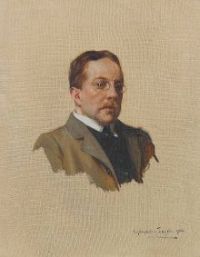
Portrait of E. W. Hornung E. W. Hornung Witching Hill — The Temple of Bacchus (1913)

But Ricardo never had his eyes off me, as we played our tiny scene among the broken columns, where Uvo and Mrs. Ricardo had just played theirs.
"Well, are you going to hold your tongue?" he asked me.
"If you hold yours," I answered.
"I mean—even as between you two!"
"That's just what I mean, Ricardo. If neither of us know what's happened, nothing else need happen. 'Least said,' you know."
"Nothing whatever must be said. I'll trust you never to tell Delavoye, and, if it makes you happier, you can trust me to say nothing to—to anybody. It's my only chance," said Ricardo, hoarsely.
Source: Wikisource

Portrait of E. W. Hornung E. W. Hornung Witching Hill — The Temple of Bacchus (1913)

The big stick leant against the end of the wall, just between us, nearer to my hand than his. The man himself leant hard against the pillar, the crop grasped behind him in both hands, its lash dangling like the tail of a monster rat. Those two clasped hands were the only part of him in the moonlight, and I watched them as I would have watched his eyes if we had been face to face.
Source: Wikisource

Portrait of E. W. Hornung E. W. Hornung Witching Hill — The Temple of Bacchus (1913)

On a warm morning it seemed a better scheme than going alone upon the river, as Uvo had suggested. I accordingly turned back with Mr. Muskett, who went on to speak of the ruin, and in fact set me on my way to it while I was setting him to the station. Ten minutes later, in a tangle of bush and bracken, I had found it: an ancient wall, scaled with patches of mouldy stucco, and at one end an Ionic pillar towering out of the sea of greenery like a lighthouse clear of the cliffs.
Source: Wikisource

Get perspective with Kwize: daily news enlightened by great literature