Summary

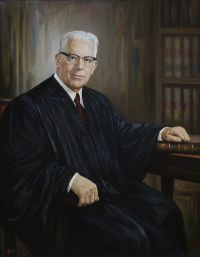
Portrait of Earl Warren Earl Warren Burgett v. Texas — Concurrence

The jury was never told, however, that two of the prior convictions charged were void and that the prosecution had failed to offer testimony on the validity of the other prior crimes charged in the indictment.
Thus, the jury went into its deliberations knowing that the petitioner had been convicted and imprisoned for four prior felonies, although not one had been proven at the trial. To expect that the jury could wipe this from its memory and decide the petitioner's guilt only on the basis of the evidence of assault is to place too much faith in a jury's ability to detach itself from reality.
Source: Wikisource

Portrait of Earl Warren Earl Warren Burgett v. Texas — Concurrence

This case is a classic example of how a rule eroding the procedural rights of a criminal defendant on trial for his life or liberty can assume avalanche proportions, burying beneath it the integrity of the fact-finding process. In Spencer, the Court approved a procedure whereby a State, for the sole purpose of enhancing punishment, includes in the indictment allegations of prior crimes which are read to the jury and enters evidence at trial of those prior crimes, no matter how unrelated they might be to the charge on which the defendant is being tried.
Source: Wikisource

Portrait of Earl Warren Earl Warren Burgett v. Texas — Concurrence

The Texas Court of Criminal Appeals disposed of the petitioner's objection to the use of the prior void convictions at trial with the cryptic observation that ' (t) here is no showing of bad faith on the part of the state in alleging or attempting to prove the prior convictions.' Boswell tells us that Dr. Johnson once observed that 'Hell is paved with good intentions.' Boswell, Life of Samuel Johnson 257 (Great Books ed. 1952) .
Source: Wikisource

Get perspective with Kwize: daily news enlightened by great literature