Summary

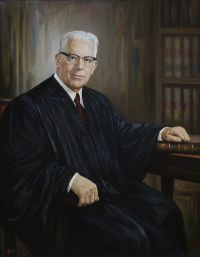
Portrait of Earl Warren Earl Warren Hannah v. Larche Hannah — Opinion of the Court

Here, we have substantially more than the mere acquiescence upon which the Government relied in Greene. There was a conscious, intentional selection by Congress of one bill, providing for none of the procedures demanded by respondents, over another bill, which provided for all of those procedures. We have no doubt that Congress' consideration and rejection of the procedures here at issue constituted an authorization to the Commission to conduct its hearings according to the Rules of Procedure it has adopted, and to deny to witnesses the rights of apprisal, confrontation, and cross-examination.
Source: Wikisource

Portrait of Earl Warren Earl Warren Hannah v. Larche Hannah — Opinion of the Court

Having considered the procedures traditionally followed by executive and legislative investigating agencies, we think it would be profitable at this point to discuss the oldest and, perhaps, the best known of all investigative bodies, the grand jury. It has never been considered necessary to grant a witness summoned before the grand jury the right to refuse to testify merely because he did not have access to the identity and testimony of prior witnesses.
Source: Wikisource

Portrait of Earl Warren Earl Warren Hannah v. Larche Hannah — Opinion of the Court

Thus, when governmental agencies adjudicate or make binding determinations which directly affect the legal rights of individuals, it is imperative that those agencies use the procedures which have traditionally been associated with the judicial process. On the other hand, when governmental action does not partake of an adjudication, as for example, when a general fact-finding investigation is being conducted, it is not necessary that the full panoply of judicial procedures be used.
Source: Wikisource

Get perspective with Kwize: daily news enlightened by great literature