Summary

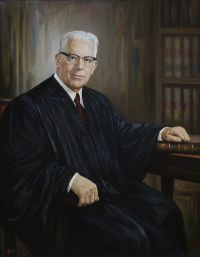
Portrait of Earl Warren Earl Warren Jacobellis v. Ohio — Dissenting Opinion (1964)

It is my belief that, when the Court said in Roth that obscenity is to be defined by reference to "community standards," it meant community standards -- not a national standard, as is sometimes argued. I believe that there is no provable "national standard," and perhaps there should be none. At all events, this Court has not been able to enunciate one, and it would be unreasonable to expect local courts to divine one. It is said that such a "community" approach may well result in material's being proscribed as obscene in one community but not in another, and, in all probability, that is true.
Source: Wikisource

Portrait of Earl Warren Earl Warren Jacobellis v. Ohio — Dissenting Opinion (1964)

But communities throughout the Nation are, in fact, diverse, and it must be remembered that, in cases such as this one, the Court is confronted with the task of reconciling conflicting [p201] rights of the diverse communities within our society and of individuals.
We are told that only "hard core pornography" should be denied the protection of the First Amendment. But who can define "hard core pornography" with any greater clarity than "obscenity"?
Source: Wikisource

Portrait of Earl Warren Earl Warren Jacobellis v. Ohio — Dissenting Opinion (1964)

As a result, courts are often presented with procedurally bad cases and, in dealing with them, appear to be acquiescing in the dissemination of obscenity. But if cases were well prepared and were conducted with the appropriate concern for constitutional safeguards, courts would not hesitate to enforce the laws against obscenity. Thus, enforcement agencies must realize that there is no royal road to enforcement; hard and conscientious work is required.
Source: Wikisource

Get perspective with Kwize: daily news enlightened by great literature