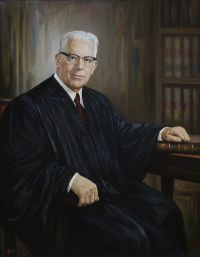
Summary

Portrait of Earl Warren Earl Warren Powell v. Cormack — Opinion of the Court

Unquestionably, Congress has an interest in preserving its institutional integrity, but in most cases that interest can be sufficiently safeguarded by the exercise of its power to punish its members for disorderly behavior and, in extreme cases, to expel a member with the concurrence of two-thirds. In short, both the intention of the Framers, to the extent it can be determined, and an examination of the basic principles of our democratic system persuade us that the Constitution does not vest in the Congress a discretionary power to deny membership by a majority vote.
Source: Wikisource

Portrait of Earl Warren Earl Warren Powell v. Cormack — Opinion of the Court

Letter XVIII of the 'Letters of Junius' bitterly attacked the exclusion of Wilkes. This letter, addressed to Blackstone, asserted:
'You cannot but know, sir, that what was Mr. Wilkes's case yesterday may be yours or mine to-morrow, and that, consequently the common right of every subject of the realm is invaded by it. * * * If the expulsion of a member, not under any legal disability, of itself creates in him an incapacity to be elected, I see a ready way marked out, by which the majority may, at any time, remove the honestest and ablest men who happen to be in opposition to them.
Source: Wikisource

Portrait of Earl Warren Earl Warren Powell v. Cormack — Opinion of the Court

If more than one issue is raised in the debates, one can never be sure on what basis the action was predicated. Unlike a court, which is presumed to be disinterested, in an exclusion case the concerned house is in effect a party to the controversy that it must adjudicate. Consequently, some members may be inclined to vote for exclusion though they strongly doubt its constitutionality.' 81 Harv.L.Rev., at 679.
Source: Wikisource

Get perspective with Kwize: daily news enlightened by great literature