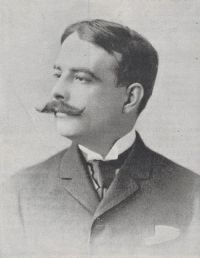
Edgar Saltus

Edgar Saltus

Summary

Portrait of Edgar Saltus Edgar Saltus Imperial Purple — Chapter IX (1892)

Rome had declined to accept the old world tenet that the soul has its avatars, yet, when Commodus sauntered from that distant sepulchre, into which, poison aiding, he had placed his putative father, Rome felt that the Egyptians were wiser than they looked; that the soul did migrate, and that in the blue eyes of the young emperor Nero's spirit shone.
Source: Wikisource

Portrait of Edgar Saltus Edgar Saltus Imperial Purple — Chapter IX (1892)

In his work on the Caesars, Suetonius drew breath but once—he called Nero a monster. Subsequently he must have regretted having done so, not because Nero was not a monster, but because it was sufficient to display the beast without adding a descriptive placard. In that was Suetonius' advantage; he could describe. Nowadays a writer may not, or at least not Heliogabalus. It is not merely that he was depraved, for all of that lot were; it was that he made depravity a pursuit; and, the purple favoring, carried it not only beyond the limits of the imaginable, but beyond the limits of the real.
Source: Wikisource

Portrait of Edgar Saltus Edgar Saltus Imperial Purple — Chapter IX (1892)

It amused Rome, too, and his prodigalities in the circus were such that Lampridus admits that the people were glad he was emperor. Neither Caligula nor Nero had been as lavish, and neither Caligula nor Nero as cruel. The atrocities he committed, if less vast than those of Caracalla's, were more acute. Domitian even was surpassed in the tortures invented by a boy, so dainty that he never used the same garments, the same shoes, the same jewels, the same woman twice.
Source: Wikisource

Get perspective with Kwize: daily news enlightened by great literature