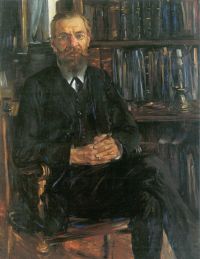
Eduard Meyer

Eduard Meyer

Summary

Portrait of Eduard Meyer Eduard Meyer 1911 Encyclopedia Britannica (1911)

When Artaxerxes II. mounted the throne, the power of Athens had been broken by Lysander, and the Greek towns in Asia were again subjects of the Persian empire. But his whole reign is a time of continuous decay; the original force of the Persians had been exhausted in luxury and intrigues, and the king, though personally brave and good-natured, was quite dependent upon his favourites and his harem, and especially upon his mother Parysatis. In the beginning of his reign falls the rebellion of his brother Cyrus, who was secretly favoured by Parysatis and by Sparta.
Source: Wikisource

Portrait of Eduard Meyer Eduard Meyer 1911 Encyclopedia Britannica (1911)

In Persis the traditions of the Achaemenian empire had always been alive, as the name of Ardashir himself shows, and with them the national religion of Zoroaster. Ardashir, who was a zealous worshipper of Ahuramazda and in intimate connexion with the magian priests, established the orthodox Zoroastrian creed as the official religion of his new kingdom, persecuted the infidels, and tried to restore the old Persian empire, which under the Achaemenids had extended over the whole of Asia from the Aegean Sea to the Indus.
Source: Wikisource

Portrait of Eduard Meyer Eduard Meyer 1911 Encyclopedia Britannica (1911)

Subsequently Greek mercenaries became indispensable not only to the king but also to the satraps, who thereby gained the means for attempting successful rebellions, into which they were provoked by the weakness of the king, and by the continuous intrigues between the Persian magnates. The reign is, therefore, a continuous succession of rebellions. Egypt soon revolted anew and could not be subdued again. When in 399 war broke out between Sparta and Persia, the Persian troops in Asia Minor were quite unable to resist the Spartan armies.
Source: Wikisource

Get perspective with Kwize: daily news enlightened by great literature