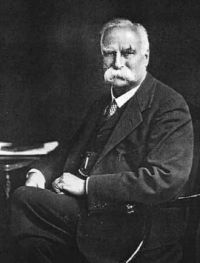
Edward Bagnall Poulton

Edward Bagnall Poulton

Summary

Portrait of Edward Bagnall Poulton Edward Bagnall Poulton The Zoologist (1900)

Its only chance of survival is to avoid experience of foes altogether; experience is the most dangerous thing in the world for an edible insect. This becomes still more obvious when we remember that failure or success is almost always determined long after the cocoon is made. The caterpillar, perhaps, spins the cocoon in autumn, but the real stress of competition will come in winter, when insect-eating animals are pressed hard with hunger, and search high and low for food. But the caterpillar is by this time a chrysalis, and of course has no opportunity of improving the cocoon.
Source: Wikisource

Portrait of Edward Bagnall Poulton Edward Bagnall Poulton The Zoologist (1900)

In every species, whether defended by the most distasteful or dangerous qualities, or the most effective concealment, no more can be achieved than to keep up the average numbers under average conditions, and this means that an immense majority of individuals are doomed to failure. As regards concealment, success merely means that enemies have so far to work for their living that in the time at their disposal they cannot do more than reduce the number of individuals to the average.
Source: Wikisource

Portrait of Edward Bagnall Poulton Edward Bagnall Poulton The Zoologist (1900)

We are thrown back, then, solely upon natural selection, which acts on the nervous system of the caterpillar, and thus compels it to make the cocoon in a certain way. In other words, those caterpillars which are impelled by their nervous system to make ill-formed conspicuous cocoons have no chance of living, and, in future stages, producing offspring. Hence the selection caused by the keen sight of foes first raises, and then maintains at a high level, the standard of cocoon-making.
Source: Wikisource

Get perspective with Kwize: daily news enlightened by great literature