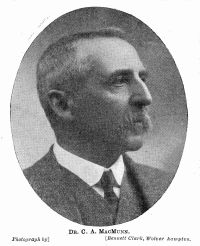
Charles Alexander MacMunn

Charles Alexander MacMunn

Summary

Portrait of Charles Alexander MacMunn Charles Alexander MacMunn 1911 Encyclopædia Britannica, Volume 6… (1911)

The production of mimicry in an individual animal has no more to do with consciousness or “taking thought” than any of the other processes of growth. Protective mimicry is here defined as an advantageous and superficial resemblance of one animal to another, which latter is specially defended so as to be disliked or feared by the majority of enemies of the groups to which both belong—a resemblance which appeals to the sense of sight, sometimes to that of hearing, and rarely to smell, but does not extend to deep-seated characters except when the superficial likeness is affected by them.
Source: Wikisource

Portrait of Charles Alexander MacMunn Charles Alexander MacMunn 1911 Encyclopædia Britannica, Volume 6… (1911)

When we further realize that in this and other examples of mimicry “the likeness is almost always detailed and remarkable, however it is attained, while the methods differ absolutely,” we recognize that natural selection is the only possible explanation hitherto suggested. In the cases of aggressive mimicry an animal resembles some object which is attractive to its prey. Examples are found in the flower-like species of Mantis, which attract the insects on which they feed.
Source: Wikisource

Portrait of Charles Alexander MacMunn Charles Alexander MacMunn 1911 Encyclopædia Britannica, Volume 6… (1911)

It is impossible to suggest, except by natural selection, any explanation of the fact that mimetic resemblances are confined to changes which produce or strengthen a superficial likeness. Very deep-seated changes are generally involved, inasmuch as the appropriate instincts as to attitude, &c., are as important as colour and marking. The same conclusion is reached when we analyse the nature of mimetic resemblance and realize how complex it really is, being made up of colours, both pigmentary and structural, pattern, form, attitude and movement.
Source: Wikisource

Get perspective with Kwize: daily news enlightened by great literature