Summary

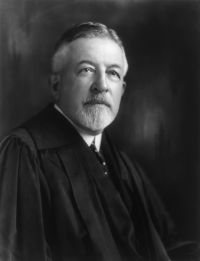
Portrait of Edward Terry Sanford Edward Terry Sanford Hecht v. Malley Howard — Opinion of the Court

We think that in the Act of 1918, in which the tax upon an association is based upon the average value of its 'capital stock,' including surplus and undivided profits, these words are not to be given a technical meaning, but should be interpreted, in their entirety, and, in the absence of a fixed share capital, as equivalent to the capital invested in the business, that is, the net value of the property owned by the association and used in its business.
Source: Wikisource

Portrait of Edward Terry Sanford Edward Terry Sanford Hecht v. Malley Howard — Opinion of the Court

On the other hand, the trustees by themselves cannot be a joint-stock association within the meaning of the act unless all trustees with discretionary powers are such, and the special provision for trustees in D. is to be made meaningless. We perceive no ground for grouping the two beneficiaries and trustees-together, in order to turn them into an association, by uniting their contrasted functions and powers, although they are in no proper sense associated.
Source: Wikisource

Portrait of Edward Terry Sanford Edward Terry Sanford Hecht v. Malley Howard — Opinion of the Court

Malley is not an authority for the broad proposition that under an Act imposing an excise tax upon the privilege of carrying on a business, a Massachusetts Trust engaged in the carrying on of business in a quasi-corporate form, in which the trustees have similar or greater powers than the directors in a corporation, is not an 'association' within the meaning of its provisions.
Source: Wikisource

Get perspective with Kwize: daily news enlightened by great literature