Summary

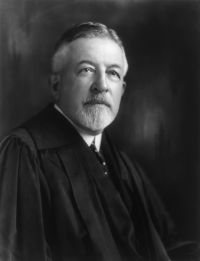
Portrait of Edward Terry Sanford Edward Terry Sanford Whitney v. California — Opinion of the Court

That such united and joint action involves even greater danger to the public peace and security than the isolated utterances and acts of individuals is clear. We cannot hold that, as here applied, the Act is an unreasonable or arbitrary exercise of the police power of the State, unwarrantably infringing any right of free speech, assembly or association, or that those persons are protected from punishment by the due process clause who abuse such rights by joining and furthering an organization thus menacing the peace and welfare of the State.
Source: Wikisource

Portrait of Edward Terry Sanford Edward Terry Sanford Whitney v. California — Opinion of the Court

The C.L.P. of California fully recognizes the value of political action as a means of spreading communist propaganda; it insists that, in proportion to the development of the economic strength of the working class, it, the working class, must also develop its political power. The C.L.P. of California proclaims and insists that the capture of political power, locally or nationally by the revolutionary working class, can be of tremendous assistance to the workers in their struggle of emancipation.
Source: Wikisource

Portrait of Edward Terry Sanford Edward Terry Sanford Whitney v. California — Opinion of the Court

The Act, plainly, meets the essential requirement of due process that a penal statute be "sufficiently explicit to inform those who are subject to it, what conduct on their part will render them liable to its penalties," and be couched in terms that are not "so vague that men of common intelligence must necessarily guess at its meaning and differ as to its application."
Source: Wikisource

Get perspective with Kwize: daily news enlightened by great literature