Summary

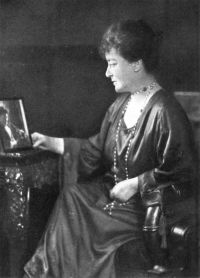
Portrait of Eliza Davis Aria Eliza Davis Aria Costume: Fanciful, Historical, and Theatrical… (1906)

Glancing roughly through the periods, I find that the dress most worn in England by the peasant women in the eleventh century consisted of a coarse woollen gown with long sleeves closely fitting to the wrists, a white linen apron, and a linen kerchief covering the head as a wimple. In the reign of Henry I. it is recorded that men wore simple tunics of red lined with white, innocent of a girdle, and open from the waist at the left side, the sleeves possessing long cuffs reaching almost to the elbow.
Source: Wikisource

Portrait of Eliza Davis Aria Eliza Davis Aria Costume: Fanciful, Historical, and Theatrical… (1906)

A plain material formed the over-skirt of many a dress which bore a striped under-skirt, tight sleeves, and a plain, tightly-fitting bodice. Cuffs and collars grew wider, the linen apron had two pockets, and there was added to costume a circular cape of dull serge. The high felt hat was adorned simply by a plain band of ribbon.
During the Restoration, colour asserted itself once more, and dress was again pretty, a comendable example having a blue linen skirt with a band of fancy material round the hem, a full basque, and a linen collar, the front adorned with braid, the apron striped.
Source: Wikisource

Portrait of Eliza Davis Aria Eliza Davis Aria Costume: Fanciful, Historical, and Theatrical… (1906)

While searching in the annals of the bygone costume of the peasant, the most democratic person might be tempted to regret the repeating of all sumptuary law. We are grateful to-day to recognise the artistic value of the red tie of the masculine tiller of the field, or of the coloured handkerchief over the head of the harvest-w^oman, but, in those other times, the plains and the fields, the woods and the forests, were the background for a people in brave array, on which blue, red, green, and white played conspicuous part.
Source: Wikisource

Get perspective with Kwize: daily news enlightened by great literature