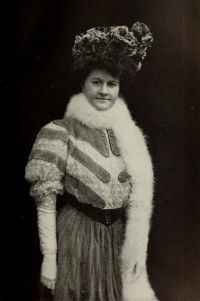
Ellen Anderson Gholson Glasgow

Ellen Anderson Gholson Glasgow

Summary

Portrait of Ellen Anderson Gholson Glasgow Ellen Anderson Gholson Glasgow The Romance of a Plain Man

The strong, heady perfume filled my nostrils, though when I remember it now it changes to the scent of wallflowers, which clings always about my memory of the old grey house, with its delicate lace curtains draped back from the small square window-panes as if a face looked out on the crooked pavement.
"Please, Aunt Mitty, let me buy a paper," begged the child.
"A paper, Sally! What on earth would you do with a paper?"
"Couldn't I roll up my hair in it, Auntie?"
"You don't roll up your hair in newspapers. Here, come in. I can't wait any longer."
Source: Gutenberg

Portrait of Ellen Anderson Gholson Glasgow Ellen Anderson Gholson Glasgow The Romance of a Plain Man

I felt a tenderness for her, as I felt a tenderness for all among whom Sally moved. The house in which she lived, the threshold she had crossed, the servants who surrounded her, were all bathed for me in the rosy light of her lamps. Common day did not shine there. I was but twenty-seven, and my eyes could still find romance in the rustle of her skirt and in the curl of her eyelash.
In the little office, where the curtains were drawn and the green-shaded lamp already lit, I found Dr. Theophilus sitting over his evening mint julep, the solitary dissipation in which I had ever seen him indulge.
Source: Gutenberg

Portrait of Ellen Anderson Gholson Glasgow Ellen Anderson Gholson Glasgow The Romance of a Plain Man

I ask something more."
"More, Sally?"
"Yes, more, Aunt Mitty, a thousand times and ten thousand times. What do I care for a dead arm that fought for a dead king? Both are dust to-day, and I am alive. No, no, give me, not honour and loyalty that have been dead five hundred years, but truth and courage that I can turn to to-day,—not chivalric phrases that are mere empty sound, but honesty and a strong arm that I can lean on."
Miss Matoaca's head had dropped as if from weariness over her thin breast, which palpitated under the piece of old lace, like the breast of a wounded bird.
Source: Gutenberg

Get perspective with Kwize: daily news enlightened by great literature