Summary

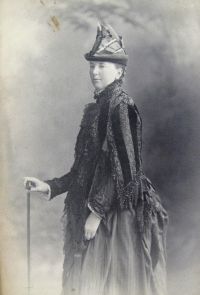
Portrait of Emily Lawless Emily Lawless The inalienable heritage, and other poems (1914)

Irish Nature was the Nature she knew best, and it inspired the last songs she gave us so gallantly, on the brink of death.
And Irish Nature was to her the symbol of all Nature, that Nature through which alone she faced mystery and found the Highest. She had in her poetry, as in herself, a twofold relation to Nature. There was the external aspect; the physical tie by which she became part of the earth and its teeming life; which made her in younger years adore movement—the rush through the air on a horse, the cleaving of the waves as she swam
Source: Gutenberg

Portrait of Emily Lawless Emily Lawless The inalienable heritage, and other poems (1914)

Entangling, swaying, revolving, escaping, past to the strand;
Escaping, yet never escaped, never utterly gone from reach;
Which is it? I ask and would know, as I watch at hand,
Here on the beach.
To-night they seem weary of warfare, these ancient foes,
Weary of love as of hate; of eddying kisses or blows;
Even as we, as I, grow weary of eddying thought,
Of the waves of the mind, of the soul and its foam-like woes,
Rising unsought.
Source: Gutenberg

Portrait of Emily Lawless Emily Lawless The inalienable heritage, and other poems (1914)

All three sources prove her a poet rather intellectual than emotional, but tense, sincere and beautifully lucid. None knew better than she that true imagination is never vague, that true vision is more definite than chairs and tables, that memorable poetry is never blurred.
There is another region of her poetic art. It is one in which her intellect yields; in which she is simple and instructive and entirely Irish. When she writes her ballads and tells stories with a swing, a lilt, a sorrowful march-music of her own, she finds, perhaps, her most native self.
Source: Gutenberg

Get perspective with Kwize: daily news enlightened by great literature