Summary

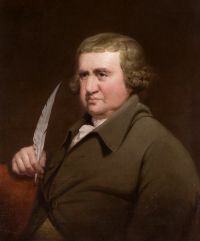
Portrait of Erasmus Darwin Erasmus Darwin Zoonomia, or, the Laws of Organic Life… (1796)

Why does the pain of the primary part of the association cease, when that of the secondary part commences? This is a question of intricacy, but perhaps not inexplicable. The pain of the primary part of these associated trains of motion was owing to too great stimulus, as of the stone at the neck of the bladder, and was consequently caused by too great action of the pained part.
Source: Wikisource

Portrait of Erasmus Darwin Erasmus Darwin Zoonomia, or, the Laws of Organic Life… (1796)

If this mode of reasoning be just it explains a curious fact, why when two parts of the body are strongly stimulated, the pain is felt only in one of them, though it is possible by voluntary attention it may be alternately perceived in them both. In the same manner, when two new ideas are presented to us from the stimulus of external bodies, we attend to but one of them at a time. In other words, when one set of fibres, whether of the muscles or organs of sense, contract so strongly as to excite much sensation
Source: Wikisource

Portrait of Erasmus Darwin Erasmus Darwin Zoonomia, or, the Laws of Organic Life… (1796)

That the act of nausea and vomiting is a decreased exertion of the fibres of the stomach may be thus deduced; when an emetic medicine is administered, it produces the pain of sickness, as a disagreeable taste in the mouth produces the pain of nausea; these pains, like that of hunger, or of cold, or like those, which are usually termed nervous, as the head-ach or hemicrania, do not excite the organ into greater action; but in this case I imagine the pains of sickness or of nausea counteract or destroy the pleasurable sensation, which seems necessary to digestion, as shewn in Sect.
Source: Wikisource

Get perspective with Kwize: daily news enlightened by great literature