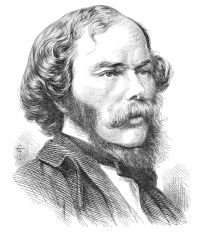
 George Henry Lewes,
Natural History Review: a quarterly journal of biological science
(1861)
George Henry Lewes,
Natural History Review: a quarterly journal of biological science
(1861)
“ I do not assert that competent physiologists ever believe that the seat of motility is elsewhere than in the muscles; what they mean is, doubtless, that the centre, from which the stimulus issues which will excite the muscles, is in the spinal chord. But how easily the ambiguous language leads to ambiguity of conception may be seen in a hundred examples; and it may be, to a great extent, avoided by rigorously demarcating the phenomena of Sensibility, Neurility, and Contractility, as the actions of three different organs: nerve-centres, nerves, and muscles. ”
