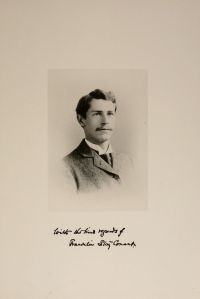
Franklin Story Conant

Franklin Story Conant

Summary

Portrait of Franklin Story Conant Franklin Story Conant The Cubomedusæ

If on the other hand he judges by the lack of pigment, the cells are visual; if by shape of cell and position of nucleus, they are both visual and pigment cells without the pigment or supporting cells. What use there would be for simple unpigmented cells in one limited region of the retina is hard to see, so he naturally takes the other horn of the dilemma and calls them visual because they have little or no pigment.
Source: Gutenberg

Portrait of Franklin Story Conant Franklin Story Conant The Cubomedusæ

In the stalk it is more columnar than the epithelium of the stomach pockets, and is made up of cells containing a brightly staining nucleus with very little trace of cytoplasm. The cell bodies appear as if filled with a clear, non-staining fluid. Perhaps these cells give the stalk elasticity to act in connection with the thin layer of longitudinal muscle-fibres that are found just external to the supporting lamella. The epithelium of the terminal enlargement of the canal is composed of very high narrow cells, many of which show two nuclei of equal size and staining quality lying side by side.
Source: Gutenberg

Portrait of Franklin Story Conant Franklin Story Conant The Cubomedusæ

The communication between the stomach and each stomach pocket is guarded by a valve that can cut the one entirely off from the other. The valve is simply the flexible lower margin of the gastric ostium, a thin vertical fold of the floor of the stomach, semilunar in shape, just at the point where it is passing over into the stomach pocket. A longitudinal section, such as is shown in Fig. 4, gives the best idea of the form and position of the valve that can be obtained from any simple section. Internal to the valve is seen a depression of the stomach wall, almost worthy to be called a pocket.
Source: Gutenberg

Get perspective with Kwize: daily news enlightened by great literature