Summary

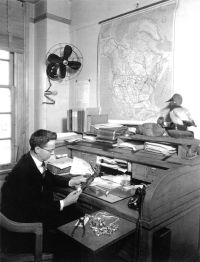
Portrait of Frederick Charles Lincoln Frederick Charles Lincoln The Migration of North American Birds…

What dangers do they face on their round-trip flight and in their winter homes? These and other questions on the migratory habits of birds puzzle the minds of many who are interested in the feathered species, whether it be the farmer who profits by their tireless warfare against the weed and insect pests of his crops, the bird student who enjoys an abundance and variety of feathered inhabitants about him, or the hunter who wants a continuation from year to year of the sport of wild-fowling.
Source: Gutenberg

Portrait of Frederick Charles Lincoln Frederick Charles Lincoln The Migration of North American Birds…

In fact, the choice of migration highways is so wide that it seems as if the routes of no two species coincide. Differences in distance traveled, in time of starting, in speed of flight, in geographical position, in latitudes of breeding and of wintering grounds, and in other factors, all contribute to this great variation of migration routes. Nevertheless, there are certain factors that serve to guide the avian travelers along more or less definite lines, and it is possible to define general lines of migration for the majority of species.
Source: Gutenberg

Portrait of Frederick Charles Lincoln Frederick Charles Lincoln The Migration of North American Birds…

The arguments against the theory of vision and memory are chiefly that much migration takes place at night and that great stretches of the open sea are crossed without hesitation. Nevertheless, the nights are rarely so dark that all terrestrial objects are totally obscured, and such features as coast lines and rivers are just those that are most likely to be seen in the faintest light, particularly by the acute vision of a bird and from its aerial points of observation. But some birds fly unerringly through the densest fog.
Source: Gutenberg

Get perspective with Kwize: daily news enlightened by great literature