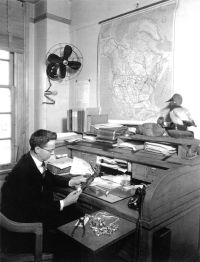
Frederick Charles Lincoln

Frederick Charles Lincoln

Summary

Portrait of Frederick Charles Lincoln Frederick Charles Lincoln Migration of Birds (1950)

There probably is no single aspect of the entire subject of bird migration that challenges our admiration so much as the unerring certainty with which birds cover thousands of miles of land and water to come to rest in exactly the same spot where they spent the previous summer or winter. The records from birds marked with numbered bands offer abundant proof that the same individuals of many species will return again and again to their identical nesting sites.
Source: Gutenberg

Portrait of Frederick Charles Lincoln Frederick Charles Lincoln Migration of Birds (1950)

These and other questions on the migratory habits of most species of Northern Hemisphere birds puzzle all who are interested in them, whether it be the farmer who profits by their tireless warfare against the weed and insect pests of his crops, the bird student who enjoys an abundance and variety of feathered inhabitants about him, or the hunter who wants a continuation from year to year of the sport of wildfowling.
Source: Gutenberg

Portrait of Frederick Charles Lincoln Frederick Charles Lincoln Migration of Birds (1950)

Throughout the ages the return flights of migratory birds have been important as a source of food after a lean winter and as the harbinger of a change in season. The arrival of certain species has been heralded with appropriate ceremonies in many lands, and among the Eskimos and other tribes the phenomenon to this day is the accepted sign of the imminence of spring and of warmer weather. The pioneer fur traders in Alaska and Canada offered rewards to the Indian or Eskimo who saw the first goose of the spring, and all joined in jubilant welcome to the newcomer.
Source: Gutenberg

Get perspective with Kwize: daily news enlightened by great literature