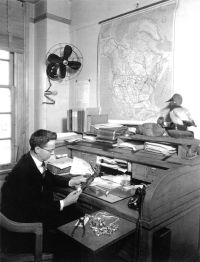
Frederick Charles Lincoln

Frederick Charles Lincoln

Summary

Portrait of Frederick Charles Lincoln Frederick Charles Lincoln Migration of Birds (1979)

Why should a bird subject itself to the rigors of a long migratory journey twice a year if it can find all the requirements suitable for existence in one locality? It seems well to consider briefly the ends that are served by this annual round trip between breeding grounds and winter quarters. Obviously, the migratory habit enables a species to enjoy the summer of northern latitudes and to avoid the severity of winter. In other words, migration makes it possible for some species to inhabit two different areas during the seasons when each presents favorable conditions.
Source: Gutenberg

Portrait of Frederick Charles Lincoln Frederick Charles Lincoln Migration of Birds (1979)

There probably is no single aspect of the entire subject of bird migration that increases our admiration so much as the unerring certainty with which birds cover thousands of miles of land and water to come to rest in exactly the same spot where they spent the previous summer or winter. Records from birds marked with numbered bands offer abundant proof that the same individuals of many species will return again and again to identical nesting or winter feeding sites.
Source: Gutenberg

Portrait of Frederick Charles Lincoln Frederick Charles Lincoln Migration of Birds (1979)

American robins and bluebirds may leave abundant food in the South and press northward when food supplies there are almost entirely lacking and severe cold and storms are likely to cause their wholesale destruction. Regularity of arrival and departure is one of the most impressive features of migration, and since birds travel in a rather strict accordance with the calendar, we might ask: "What phenomena, other than the regular changes in length of day, occur with sufficient precision to act as a stimulus for migration?"
Source: Gutenberg

Get perspective with Kwize: daily news enlightened by great literature