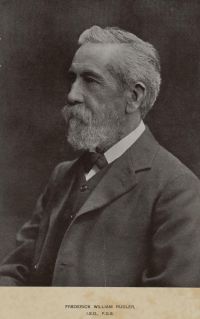
Frederick William Rudler

Frederick William Rudler

Summary

Portrait of Frederick William Rudler Frederick William Rudler 1911 Encyclopædia Britannica (1911)

When, as occasionally though not often happens, the effects of a submarine eruption are observed during the disturbance, it is seen that the surface of the sea is violently agitated, with copious discharge of steam, the water passes into a state of ebullition, perhaps throwing up huge fountains; shoals of dead fishes, with volcanic cinders, bombs and fragments of pumice, float around the centre of eruption, and ultimately a little island may appear above sea-level.
Source: Wikisource

Portrait of Frederick William Rudler Frederick William Rudler 1911 Encyclopædia Britannica (1911)

CARBONADO, a name given in Brazil to a dark massive form of impure diamond, known also as “carbonate” and in trade simply as carbon. It is sometimes called black diamond. Generally it is found in small masses of irregular polyhedral form, black, brown or dark-grey in colour, with a dull resinoid lustre; and breaking with a granular fracture, paler in colour, and in some cases much resembling that of fine-grained steel. Being slightly cellular, its specific gravity is rather less than that of crystallized diamond.
Source: Wikisource

Portrait of Frederick William Rudler Frederick William Rudler 1911 Encyclopædia Britannica (1911)

The electrical phenomena attending an eruption are often of great intensity and splendour. The dark ash-laden clouds of vapour are shot through and through by volcanic lightning, sometimes in rapid horizontal flashes, then in oblique forked streaks, or again in tortuous lines compared to fiery serpents, whilst the borders of the cloud may be brilliant with electric scintillations, often forming balls and stars of fire.
Source: Wikisource

Get perspective with Kwize: daily news enlightened by great literature