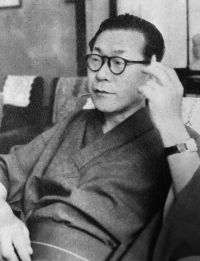
Fusao Hayashi

Fusao Hayashi

Summary

Portrait of Fusao Hayashi Fusao Hayashi The Cannery Boat — Cocoons (1933)

Whenever I see cocoons I am reminded of Yasuo Sakai. Of late I have become so completely a city-dweller that it is only by the patterns of autumn grasses on fabrics in the shop-windows that I know the autumn has come. No longer can I wander along country lanes where migrant crows drop seeds as they fly, the baskets of live cocoons swaying on the carts as if they would topple off at any minute.
Source: Wikisource

Portrait of Fusao Hayashi Fusao Hayashi The Cannery Boat — Cocoons (1933)

My mother holds to it almost like a religion that the ruin of the Sakai family is our fault and that we must somehow restore it. Not only that, but, as a mother, she naturally feels a deep joy and an object in life is giving a proper education to her only child. I can understand that feeling quite well.
“But so long as she’s in that mill, isn’t she, too, just one of those miserable silkworm cocoons? An invisible silken thread is drawing, drawing at her life, too...”
Source: Wikisource

Portrait of Fusao Hayashi Fusao Hayashi The Cannery Boat — Cocoons (1933)

The colour left Okawa’s lips. Sakai’s face, too, seemed to go a shade paler. Swiftly as a rat Okawa scurried, but Sakai ran him down near the place he had once squashed the snake. The patch stopped there. Okawa stood waiting with the strength of one at bay.
“Stab me if you dare.” Peeling off his coat, Okawa threw it on the grass and in the manner of all bluffers he bared his breast and extended both arms.
“You think I won’t stab you?” Sakai’s voice sounded strangely calm and collected. The gleam of cold steel rent the air.
Source: Wikisource

Get perspective with Kwize: daily news enlightened by great literature