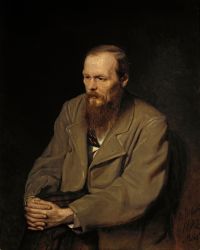
Fyodor Dostoevsky

Fyodor Dostoevsky

The Idiot — Part II, Chapter II (1913<!--year of translation-->)

Summary

Portrait of Fyodor Dostoevsky Fyodor Dostoevsky The Idiot — Part II, Chapter II (1913<!--year of translation-->)

Lebedeff invited his guest to sit down on a green seat before a table of the same colour fixed in the earth, and took a seat facing him. In a few minutes the coffee appeared, and the prince did not refuse it. The host kept his eyes fixed on Muishkin, with an expression of passionate servility.
"I knew nothing about your home before," said the prince absently, as if he were thinking of something else.
"Poor orphans," began Lebedeff, his face assuming a mournful air, but he stopped short, for the other looked at him inattentively, as if he had already forgotten his own remark.
Source: Wikisource

Portrait of Fyodor Dostoevsky Fyodor Dostoevsky The Idiot — Part II, Chapter II (1913<!--year of translation-->)

But what is there that people will not smile at?
The prince took a cab and drove to a street near the Nativity, where he soon discovered the house he was seeking. It was a small wooden villa, and he was struck by its attractive and clean appearance; it stood in a pleasant little garden, full of flowers. The windows looking on the street were open, and the sound of a voice, reading aloud or making a speech, came through them. It rose at times to a shout, and was interrupted occasionally by bursts of laughter.
Prince Muishkin entered the court-yard, and ascended the steps.
Source: Wikisource

Portrait of Fyodor Dostoevsky Fyodor Dostoevsky The Idiot — Part II, Chapter II (1913<!--year of translation-->)

Colia heard it too. He is as mad as a March hare!"
"You hear how he slanders me, prince," said Lebedeff, almost beside himself with rage. "I may be a drunkard, an evil-doer, a thief, but at least I can say one thing for myself. He does not know—how should he, mocker that he is?—that when he came into the world it was I who washed him, and dressed him in his swathing-bands, for my sister Anisia had lost her husband, and was in great poverty.
Source: Wikisource

Get perspective with Kwize: daily news enlightened by great literature