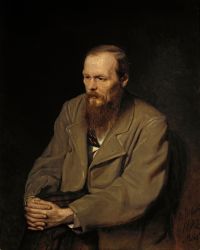
Fyodor Dostoevsky

Fyodor Dostoevsky

The Idiot — Part II/Chapter V (1913<!--year of translation-->)

Summary

Portrait of Fyodor Dostoevsky Fyodor Dostoevsky,  The Idiot — Part II/Chapter V (1913<!--year of translation-->)

“ For him, the prince, to love this woman with passion, was unthinkable. It would be cruel and inhuman. Yes. Rogojin is not fair to himself; he has a large heart; he has aptitude for sympathy. When he learns the truth, and finds what a pitiable being is this injured, broken, half-insane creature, he will forgive her all the torment she has caused him. He will become her slave, her brother, her friend. Compassion will teach even Rogojin, it will show him how to reason. Compassion is the chief law of human existence. Oh, how guilty he felt towards Rogojin! ”
Source: Wikisource

Portrait of Fyodor Dostoevsky Fyodor Dostoevsky,  The Idiot — Part II/Chapter V (1913<!--year of translation-->)

“ What's more unanswerable than a fact? And this fact had occurred. The prince had confessed unreservedly to himself that the feeling of intense beatitude in that crowded moment made the moment worth a lifetime. "I feel then," he said one day to Rogojin in Moscow, "I feel then as if I understood those amazing words—'There shall be no more time.'" And he added with a smile: "No doubt the epileptic Mahomet refers to that same moment when he says that he visited all the dwellings of Allah, in less time than was needed to empty his pitcher of water." ”
Source: Wikisource

Portrait of Fyodor Dostoevsky Fyodor Dostoevsky,  The Idiot — Part II/Chapter V (1913<!--year of translation-->)

“ Yes, he had often met Rogojin in Moscow, and many were the subjects they discussed. "He told me I had been a brother to him," thought the prince. "He said so today, for the first time."
He was sitting in the Summer Garden on a seat under a tree, and his mind dwelt on the matter. It was about seven o'clock, and the place was empty. The stifling atmosphere foretold a storm, and the prince felt a certain charm in the contemplative mood which possessed him. He found pleasure, too, in gazing at the exterior objects around him.
”
Source: Wikisource

Get perspective with Kwize: daily news enlightened by great literature