Mahomet

Definition and stakes

Herbert Junius Hardwicke,  Evolution and creation

“ Mahomet, or Mohammed, was a young religious enthusiast, a camel-driver of Mecca, who determined to uproot the idolatry and superstition of the Arab tribes, and was singularly successful in his arduous undertaking. He had a powerful aversion to all kinds of priestcraft, sacrifices, and superstitious ordeals, and boldly preached the unity of God, declaring that “there is but one God, and Mahomet is his prophet.” Of all the religions of the world, perhaps none has been more successful than this; and, certainly, not one ever spread so rapidly over the face of the earth. ”
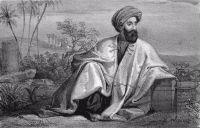
Source: Gutenberg

Thomas Carlyle,  On Heroes, Hero-Worship, and The Heroic in History (1841)

“ These journeys to Syria were probably the beginning of much to Mahomet.
One other circumstance we must not forget: that he had no school-learning; of the thing we call school-learning none at all. The art of writing was but just introduced into Arabia; it seems to be the true opinion that Mahomet never could write! Life in the Desert, with its experiences, was all his education. What of this infinite Universe he, from his dim place, with his own eyes and thoughts, could take in, so much and no more of it was he to know.
”
Source: Gutenberg

Portrait of Charles Lewis Meryon Charles Lewis Meryon,  Travels of Lady Hester Stanhope… (1846)

“ Every night several individuals might be seen parading the streets, bawling in a dissonant tone,—“There is no other God but the Lord.” Others, assembled together in rooms, formed themselves into a ring, and imitated the cries and impassioned gestures of the howling dervises, to the sound of the tabor. Whatever merit the religion of Mahomet may have, it certainly has no attractions from its liturgy: and, whether from the minaret or in the mosque, their chant is far from pleasant to the ear. ”
Source: Gutenberg

Get perspective with Kwize: daily news enlightened by great literature