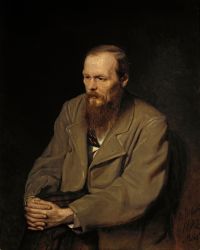
Fyodor Dostoevsky

Fyodor Dostoevsky

The Idiot — Part II/Chapter VII (1913<!--year of translation-->)

Summary

Portrait of Fyodor Dostoevsky Fyodor Dostoevsky,  The Idiot — Part II/Chapter VII (1913<!--year of translation-->)

“ To the amazement of the prince, who overheard the remark, Aglaya looked haughtily and inquiringly at the questioner, as though she would give him to know, once for all, that there could be no talk between them about the 'poor knight,' and that she did not understand his question.
"But not now! It is too late to send to town for a Pushkin now. It is much too late, I say!" Colia was exclaiming in a loud voice. "I have told you so at least a hundred times."
"Yes, it is really much too late to send to town now," said Evgenie Pavlovitch, who had escaped from Aglaya as rapidly as possible.
”
Source: Wikisource

Portrait of Fyodor Dostoevsky Fyodor Dostoevsky,  The Idiot — Part II/Chapter VII (1913<!--year of translation-->)

“ They have waited some time, and are beginning to make a fuss, and papa will not bring them in."
"Who are these people?" said the prince.
"They say that they have come on business, and they are the kind of men, who, if you do not see them here, will follow you about the street. It would be better to receive them, and then you will get rid of them. Gavrila Ardalionovitch and Ptitsin are both there, trying to make them hear reason."
"Pavlicheff's son! It is not worth while!" cried Lebedeff. "There is no necessity to see them, and it would be most unpleasant for your excellency.
”
Source: Wikisource

Portrait of Fyodor Dostoevsky Fyodor Dostoevsky,  The Idiot — Part II/Chapter VII (1913<!--year of translation-->)

“ They go straight to the point. For them, it is not a question of showing that Pushkin is stupid, or that Russia must be torn in pieces. No; but if they have a great desire for anything, they believe they have a right to get it even at the cost of the lives, say, of eight persons. They are checked by no obstacles. In fact, prince, I should not advise you ..."
But Muishkin had risen, and was on his way to open the door for his visitors.
"You are slandering them, Lebedeff," said he, smiling.
"You are always thinking about your nephew's conduct.
”
Source: Wikisource

Get perspective with Kwize: daily news enlightened by great literature