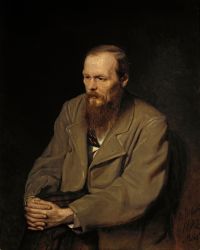
Fyodor Dostoevsky

Fyodor Dostoevsky

The Idiot — Part II/Chapter VIII (1913<!--year of translation-->)

Summary

Portrait of Fyodor Dostoevsky Fyodor Dostoevsky,  The Idiot — Part II/Chapter VIII (1913<!--year of translation-->)

“ Do you believe that in this affair of Burdovsky you have right on your side? Do you admit that Pavlicheff overwhelmed you with benefits, and perhaps saved your life? If you admit it (which we take for granted) , do you intend, now that you are a millionaire, and do you not think it in conformity with justice, to indemnify Burdovsky? Yes or no? If it is yes, or, in other words, if you possess what you call honour and conscience, and we more justly call common-sense, then accede to our demand, and the matter is at an end. Give us satisfaction, without entreaties or thanks from us ”
Source: Wikisource

Portrait of Fyodor Dostoevsky Fyodor Dostoevsky,  The Idiot — Part II/Chapter VIII (1913<!--year of translation-->)

“ Lebedeff could restrain himself no longer; he made his way through the row of chairs.
"Prince," he cried, "you are forgetting that if you consented to receive and hear them, it was only because of your kind heart which has no equal, for they had not the least right to demand it, especially as you had placed the matter in the hands of Gavrila Ardalionovitch, which was also extremely kind of you. You are also forgetting, most excellent prince, that you are with friends, a select company; you cannot sacrifice them to these gentlemen, and it is only for you to have them turned out this instant.
”
Source: Wikisource

Portrait of Fyodor Dostoevsky Fyodor Dostoevsky,  The Idiot — Part II/Chapter VIII (1913<!--year of translation-->)

“ Really, prince, do you think we are such fools as not to be aware that this matter does not come within the law, and that legally we cannot claim a rouble from you? But we are also aware that if actual law is not on our side, human law is for us, natural law, the law of common-sense and conscience, which is no less binding upon every noble and honest man—that is, every man of sane judgment—because it is not to be found in miserable legal codes. ”
Source: Wikisource

Get perspective with Kwize: daily news enlightened by great literature