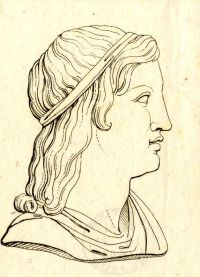
Gaius Suetonius Tranquillus

Gaius Suetonius Tranquillus

Summary

Portrait of Gaius Suetonius Tranquillus Gaius Suetonius Tranquillus The Lives of the Twelve Caesars…

Then Caesar cried: "Take we the course which the signs of the gods and the false dealing of our foes point out. The die is cast," said he.
33 Accordingly, crossing with his army, and welcoming the tribunes of the commons, who had come to him after being driven from Rome, he harangued the soldiers with tears, and rending his robe from his breast besought their faithful service.
Source: Wikisource

Portrait of Gaius Suetonius Tranquillus Gaius Suetonius Tranquillus The Lives of the Twelve Caesars…

Helvinus Cinna, tribune of the commons, admitted to several that he had a bill drawn up in due form, which Caesar had ordered him to propose to the people in his absence, making it lawful for Caesar to marry what wives he wished, and as many as he wished, "for the purpose of begetting children." But to remove all doubt that he had an evil reputation both for shameless vice and for adultery, I have only to add that the elder Curio is one of his speeches calls him "every woman's man and every man's woman."
Source: Wikisource

Portrait of Gaius Suetonius Tranquillus Gaius Suetonius Tranquillus The Lives of the Twelve Caesars…

With regard to Caesar's memoirs Cicero, also in the Brutus speaks in the following terms: "He wrote memoirs which deserve the highest praise; they are naked in their simplicity, straightforward yet graceful, stripped of all rhetorical adornment, as of a garment; but while his purpose was to supply material to other, on which those who wished to write history may draw, he haply gratified silly folk, who will try to use the curling-irons on his narrative, but he had kept men of any sense from touching the subject."
Source: Wikisource

Get perspective with Kwize: daily news enlightened by great literature