Summary

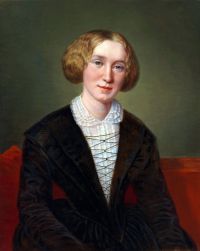
Portrait of George Eliot George Eliot The Mill on the Floss — Book 6… (1860)

It may be surprising that Maggie, among whose many imperfections an excessive delight in admiration and acknowledged supremacy were not absent now, any more than when she was instructing the gypsies with a view toward achieving a royal position among them, was not more elated on a day when she had had the tribute of so many looks and smiles, together with that satisfactory consciousness which had necessarily come from being taken before Lucy's chevalglass, and made to look at the full length of her tall beauty, crowned by the night of her massy hair.
Source: Wikisource

Portrait of George Eliot George Eliot The Mill on the Floss — Book 6… (1860)

The middle-aged, who have lived through their strongest emotions, but are yet in the time when memory is still half passionate and not merely contemplative, should surely be a sort of natural priesthood, whom life has disciplined and consecrated to be the refuge and rescue of early stumblers and victims of self-despair. Most of us, at some moment in our young lives, would have welcomed a priest of that natural order in any sort of canonicals or uncanonicals, but had to scramble upward into all the difficulties of nineteen entirely without such aid, as Maggie did.
Source: Wikisource

Portrait of George Eliot George Eliot The Mill on the Floss — Book 6… (1860)

Kenn with an expression of reliance, as if she had told him her history in those three words. It was one of those moments of implicit revelation which will sometimes happen even between people who meet quite transiently,–on a mile's journey, perhaps, or when resting by the wayside. There is always this possibility of a word or look from a stranger to keep alive the sense of human brotherhood.
Dr. Kenn's ear and eye took in all the signs that this brief confidence of Maggie's was charged with meaning.
Source: Wikisource

Get perspective with Kwize: daily news enlightened by great literature