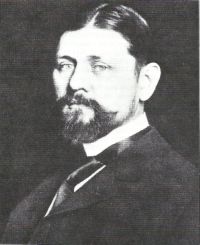
George Frederick Kunz

George Frederick Kunz

Summary

Portrait of George Frederick Kunz George Frederick Kunz 1911 Encyclopædia Britannica, Volume 16… (1911)

He opened a diamond-cutting establishment about 1860 and carried it on for some years, training a number of young men and women, who became the best cutters in the country. But the chief importance of his work lay in its superior quality. So long had it been a monopoly of the Dutch and Belgians that it was declining into a mere mechanical trade. Morse studied the diamond scientifically and taught his pupils how important mathematical exactitude in cutting was to the beauty and value of the gem. He thus attained a perfection rarely seen before, and gave a great stimulus to the art.
Source: Wikisource

Portrait of George Frederick Kunz George Frederick Kunz 1911 Encyclopædia Britannica, Volume 16… (1911)

With the Renaissance, the art of gem carving revived, and the engravers from that time and onward have produced results that equal the best Greek and Roman work; copies of ancient gem carvings made by some of the 18th-century masters are only distinguishable from true antiques by experts of great proficiency. It is in fact extremely difficult to judge positively as to the age of engraved gems.
Source: Wikisource

Portrait of George Frederick Kunz George Frederick Kunz 1911 Encyclopædia Britannica, Volume 16… (1911)

The rose form is used for diamonds not thick enough to cut as brilliants; it is flat below and has 12 to 24, or sometimes 32, triangular facets above, in three rows, meeting in a point. Stones thus cut are also known as “roses couronnées”; others with fewer facets, twelve or even six, are called “roses d’Anvers,” and are a specialty, as their name implies, at Antwerp. These, however, are only cut from very thin or shallow stones. None of the rose-cut diamonds is equal in beauty to the brilliants.
Source: Wikisource

Get perspective with Kwize: daily news enlightened by great literature