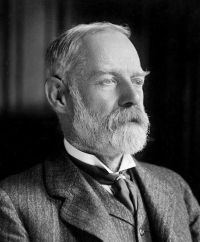
George Howard Darwin

George Howard Darwin

Summary

Portrait of George Howard Darwin George Howard Darwin Dictionary of National Biography… (1912)

The study of heredity led Galton to the conviction that the human race might gain an indefinite improvement by breeding from the best and restricting the offspring of the worst. To this study he gave the name of 'eugenics,' and it is probably by this that he will be best known in the future. But he was under no illusion as to the rapidity with which favourable results may be attained, and he foresaw that it would need a prolonged education before an adequate knowledge of the power of heredity shall permeate the community.
Source: Wikisource

Portrait of George Howard Darwin George Howard Darwin Dictionary of National Biography… (1912)

Meteorology did not nearly suffice to occupy Galton's active mind; already in 1865 he was occupied with those researches into the laws of heredity with which his name will always be associated. In the course of these investigations he was led to perceive the deficiency of tabulated data as to human attributes. He therefore initiated an anthropometric laboratory in connection with the International Health Exhibition of 1884-6, for the purpose of collecting statistics as to the acuteness of the senses, the strength, height, and dimensions of large numbers of people.
Source: Wikisource

Portrait of George Howard Darwin George Howard Darwin Dictionary of National Biography… (1912)

On the publication in 1859 of the 'Origin of Species' by his cousin, Charles Robert Darwin (1809-1882) [q. v.] , Galton at once became a convert to the views there enounced and began reflecting on the influence of heredity on the human race. He had been impressed by his own observation with the fact that distinction of any kind is apt to him in families. He therefore made a series of statistical inquiries whereby he proved the heritability of genius of all kinds. These investigations extended over forty years, and the results are set forth in his works: 'Hereditary Genius' (1869)
Source: Wikisource

Get perspective with Kwize: daily news enlightened by great literature