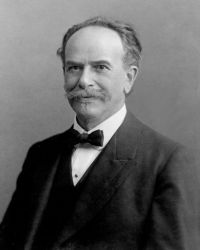
Franz Boas

Franz Boas

Eugenics (1916)

Summary

Portrait of Franz Boas Franz Boas,  Eugenics (1916)

“ Considering then the fundamental differences in ideals of distinct types of civilization, have we a right to give to our modern ideals the stamp of finality, and suppress what does not fit into our life? There is little doubt that we, at the present time, give much less weight to beauty than to logic. Shall we then try to raise a generation of logical thinkers, suppress those whose emotional life is vigorous, and try to bring it about that reason shall reign supreme, and that human activities shall be performed with clock-like precision? ”
Source: Wikisource

Portrait of Franz Boas Franz Boas,  Eugenics (1916)

“ The wish for the elimination of unnecessary suffering is divided by a narrow margin from the wish for the elimination of all suffering. While, humanely speaking, this may be a beautiful ideal, it is unattainable. The performance of the labors of mankind and the conflict of duties will always be accompanied by suffering that must be borne, and that men must be willing to bear. Many of the works of sublime beauty are the precious fruit of mental agony; and we should be poor, indeed, if the willingness of man to suffer should disappear. ”
Source: Wikisource

Portrait of Franz Boas Franz Boas,  Eugenics (1916)

“ The anthropologist, on the other hand, can not acknowledge such a complete domination of emotion by reason. He rather sees the steady advance of the rational knowledge of mankind, which is a source of satisfaction to him no less than to the biologist; but he sees also that mankind does not put this knowledge to purely reasonable use, but that its actions are swayed by emotions no less now than in former times, although the increase of knowledge limits the extreme forms of unreasonable emotional activities. ”
Source: Wikisource

Get perspective with Kwize: daily news enlightened by great literature