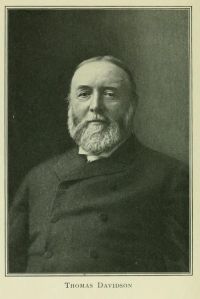
Thomas Davidson

Thomas Davidson

Summary

Portrait of Thomas Davidson Thomas Davidson,  The Philosophical Review (1892)

“ When we say 'moral world,' we mean a world in which moral action is possible; when we say ' moral action,' we mean action in which morality is realized. Realized morality is virtue. Now there are such things as virtuous acts; but no one would say that the world is virtuous.
The type of the moral world is a great co-operative factory, and is maintained "by the free participation therein of individual wills."
”
Source: Wikisource

Portrait of Thomas Davidson Thomas Davidson,  The Philosophical Review (1892)

“ It is in contrast with Christian ethics that the system of Plato exhibits its character most clearly. The Platonic ethics aim at a harmony, the conditions of which can be learnt only through knowledge and insight, hence the fundamental virtue is Wisdom (σοφία) ; Christian ethics aim at the inspiration of the Holy Spirit; hence the fundamental Christian virtue is faith ripening, through hope, into love. It is needless to say that one of the chief efforts of modern ethical thinking, as well as of modern civilization, has been to reconcile these two points of view. ”
Source: Wikisource

Portrait of Thomas Davidson Thomas Davidson,  The Philosophical Review (1892)

“ But when we speak of a certain kind of actions as moral, do we not employ "moral" in a sense different from that implied by it in the expression "moral world"? Few persons would deny that the "moral world is here and now"; but most persons would deny that all actions are moral, unless, indeed, 'action' be used in a very unusual sense, — as moral action. ”
Source: Wikisource

Get perspective with Kwize: daily news enlightened by great literature