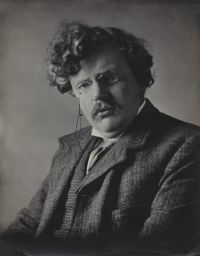
Gilbert Keith Chesterton

Gilbert Keith Chesterton

Summary

Portrait of Gilbert Keith Chesterton Gilbert Keith Chesterton,  Heretics — Chapter 2: On the Negative Spirit (1905)

“ Nobody has any business to use the word "progress" unless he has a definite creed and a cast-iron code of morals. Nobody can be progressive without being doctrinal; I might almost say that nobody can be progressive without being infallible --at any rate, without believing in some infallibility. For progress by its very name indicates a direction; and the moment we are in the least doubtful about the direction, we become in the same degree doubtful about the progress. Never perhaps since the beginning of the world has there been an age that had less right to use the word "progress" than we. ”
Source: Wikisource

Portrait of Gilbert Keith Chesterton Gilbert Keith Chesterton,  Heretics — Chapter 2: On the Negative Spirit (1905)

“ We meet every ideal of religion, patriotism, beauty, or brute pleasure with the alternative ideal of progress--that is to say, we meet every proposal of getting something that we know about, with an alternative proposal of getting a great deal more of nobody knows what. Progress, properly understood, has, indeed, a most dignified and legitimate meaning. But as used in opposition to precise moral ideals, it is ludicrous. So far from it being the truth that the ideal of progress is to be set against that of ethical or religious finality, the reverse is the truth. ”
Source: Wikisource

Portrait of Gilbert Keith Chesterton Gilbert Keith Chesterton,  Heretics — Chapter 2: On the Negative Spirit (1905)

“ But let us never forget that this visionary religion is, in one sense, necessarily more wholesome than our modern and reasonable morality. It is more wholesome for this reason, that it can contemplate the idea of success or triumph in the hopeless fight towards the ethical ideal, in what Stevenson called, with his usual startling felicity, "the lost fight of virtue." A modern morality, on the other hand, can only point with absolute conviction to the horrors that follow breaches of law; its only certainty is a certainty of ill. It can only point to imperfection. ”
Source: Wikisource

Get perspective with Kwize: daily news enlightened by great literature