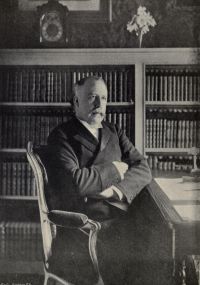
George William Erskine Russell

George William Erskine Russell

Summary

Portrait of George William Erskine Russell George William Erskine Russell 1911 Encyclopædia Britannica, Volume 12… (1911)

The government was formed on the understanding that Mr Roebuck’s proposed committee was to be resisted. Lord Palmerston soon saw that further resistance was useless; his Peelite colleagues stuck to their text, and, within three weeks after resuming office, Gladstone, Sir James Graham and Mr Sidney Herbert resigned. Gladstone once said of himself and his Peelite colleagues, during the period of political isolation, that they were like roving icebergs on which men could not land with safety, but with which ships might come into perilous collision.
Source: Wikisource

Portrait of George William Erskine Russell George William Erskine Russell 1911 Encyclopædia Britannica, Volume 12… (1911)

When the session of 1873 had come to an end Gladstone took the chancellorship of the exchequer, and, as high authorities contended, vacated his seat by doing so. The point was obviously one of vital importance; and we learn from Lord Selborne, who was lord chancellor at the time, that Gladstone “was sensible of the difficulty of either taking his seat in the usual manner at the opening of the session, or letting ... the necessary arrangements for business in the House of Commons be made in the prime minister’s absence. A dissolution was the only escape.”
Source: Wikisource

Portrait of George William Erskine Russell George William Erskine Russell 1911 Encyclopædia Britannica, Volume 12… (1911)

War between Great Britain and Russia was declared on the 27th of March 1854, and it thus fell to the lot of the most pacific of ministers, the devotee of retrenchment, and the anxious cultivator of all industrial arts, to prepare a war budget, and to meet as well as he might the exigencies of a conflict which had so cruelly dislocated all the ingenious devices of financial optimism.
Source: Wikisource

Get perspective with Kwize: daily news enlightened by great literature