Summary

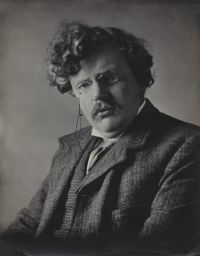
Portrait of Gilbert Keith Chesterton Gilbert Keith Chesterton A Short History of England — Chapter II. The Province of England (1917)

What they cared about was getting and giving in Britain what they had got and given in Gaul. We do not know whether the Britons then, or for that matter the Britons now, were Iberian or Cymric or Teutonic. We do know that in a short time they were Roman.
Every now and then there is discovered in modern England some fragment such as a Roman pavement. Such Roman antiquities rather diminish than increase the Roman reality. They make something seem distant which is still very near, and something seem dead that is still alive. It is like writing a man's epitaph on his front door.
Source: Wikisource

Portrait of Gilbert Keith Chesterton Gilbert Keith Chesterton A Short History of England — Chapter II. The Province of England (1917)

They are Roman remains. In truth they are not so much remains as relics; for they are still working miracles. A row of poplars is a more Roman relic than a row of pillars. Nearly all that we call the works of nature have but grown like fungoids upon this original work of man; and our woods are mosses on the bones of a giant. Under the seed of our harvests and the roots of our trees is a foundation of which the fragments of tile and brick are but emblems; and under the colours of our wildest flowers are the colours of a Roman pavement.
Britain was directly Roman for fully four hundred years
Source: Wikisource

Portrait of Gilbert Keith Chesterton Gilbert Keith Chesterton A Short History of England — Chapter II. The Province of England (1917)

Being Roman did not mean being subject, in the sense that one savage tribe will enslave another, or in the sense that the cynical politicians of recent times watched with a horrible hopefulness for the evanescence of the Irish. Both conquerors and conquered were heathen, and both had the institutions which seem to us to give an inhumanity to heathenism: the triumph, the slave-market, the lack of all the sensitive nationalism of modern history. But the Roman Empire did not destroy nations; if anything, it created them. Britons were not originally proud of being Britons
Source: Wikisource

Get perspective with Kwize: daily news enlightened by great literature