Summary

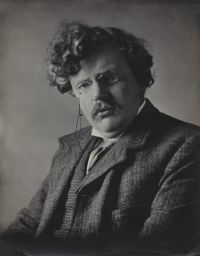
Portrait of Gilbert Keith Chesterton Gilbert Keith Chesterton Appreciations and Criticisms of the Works of Charles Dickens… (1911)

Everywhere in Dickens's work these angles of his absolute opinion stood up out of the confusion of his general kindness, just as sharp and splintered peaks stand up out of the soft confusion of the forests. Dickens is always generous, he is generally kind-hearted, he is often sentimental, he is sometimes intolerably maudlin; but you never know when you will not come upon one of the convictions of Dickens; and when you do come upon it you do know it. It is as hard and as high as any precipice or peak of the mountains. The highest and hardest of these peaks is Hard Times.
Source: Wikisource

Portrait of Gilbert Keith Chesterton Gilbert Keith Chesterton Appreciations and Criticisms of the Works of Charles Dickens… (1911)

And it is singularly suggestive that in English literature the two things have died together. The very people who would blame Dickens for his sentimental hospitality are the very people who would also blame him for his narrow political conviction. The very people who would mock him for his narrow radicalism are those who would mock him for his broad fireside. Real conviction and real charity are much nearer than people suppose. Dickens was capable of loving all men; but he refused to love all opinions. The modern humanitarian can love all opinions, but he cannot love all men
Source: Wikisource

Portrait of Gilbert Keith Chesterton Gilbert Keith Chesterton Appreciations and Criticisms of the Works of Charles Dickens… (1911)

He is by his own account dealing with hard times, but not with a hard eternity, not with a hard philosophy of the universe. Nevertheless, this is the one place in his work where he does not make us remember human happiness by example as well as by precept. This is, as I have said, not the saddest, but certainly the harshest of his stories. It is perhaps the only place where Dickens, in defending happiness, for a moment forgets to be happy.
Source: Wikisource

Get perspective with Kwize: daily news enlightened by great literature