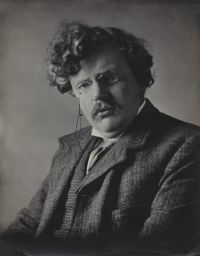
Gilbert Keith Chesterton

Gilbert Keith Chesterton

Summary

Portrait of Gilbert Keith Chesterton Gilbert Keith Chesterton The Apostle and the Wild Ducks… (1975)

I can only explain all this by my private theory of tyrants; which is this. Men do not rebel against the old; rather they rebel against the new. They turn upon something when they find that it has them in a trap. They do not revolt against something that has been unpopular. They revolt (and very rightly) against something that has been popular. They hated Charles I because they had loved Elizabeth.
Source: Wikisource

Portrait of Gilbert Keith Chesterton Gilbert Keith Chesterton The Apostle and the Wild Ducks… (1975)

We had escaped the snare of Philip; we walked into the snare of Elizabeth; we broke out of the snare of Charles I.
This is the essential mark of tyranny: that it is always new. Tyranny always enters by the unguarded gate. The tyrant is always shy and unobtrusive. The tyrant is always a traitor. He has always come there on the pretence that he was protecting something which people really wanted protected--religion, or public justice, or patriotic glory. Men staring at the Armada
Source: Wikisource

Portrait of Gilbert Keith Chesterton Gilbert Keith Chesterton The Apostle and the Wild Ducks… (1975)

A Theory of Tyrants I have come to be convinced of late of a certain theory of the nature of tyranny. It may be right or wrong, but I think it is at least worthy of thought in connection with a highly interesting matter. Broadly speaking, the common theory of tyranny has been this: That men have groaned under some system for centuries, and have at last rebelled against it. But I think that men have actually done quite otherwise; they have rebelled against the system against which they have not groaned.
Source: Wikisource

Get perspective with Kwize: daily news enlightened by great literature