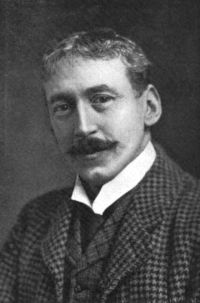
H. De Vere Stacpoole

H. De Vere Stacpoole

Summary

Portrait of H. De Vere Stacpoole H. De Vere Stacpoole The Mound of Darkness (1916)

He spoke to the watch, and then climbed to the bridge, where he lit a cigarette and stood for a moment looking at the view.
The great moon, nearly full, had risen over the forest, and the bayou lay like a sheet of silver to the tree line of the distant banks. Bats were flitting above the trees, a night moth came fluttering along on the windless air, and away out on the water a dark streak marked the course of some swimming animal or reptile.
Nothing could be more ghostly, more beautiful, more mysterious than the great bayou seen like this by moonlight.
Source: Wikisource

Portrait of H. De Vere Stacpoole H. De Vere Stacpoole The Mound of Darkness (1916)

The ferns form a wonderland of their own, filling the glades with a delicate tracery, hauntingly beautiful. Seen through the veils of the barrier lianas, the air is a garden.
Looking up, Pinckney was fascinated by the tangle above, the soaring air shoots and water shoots, the sagging lianas, cable-thick and tufted with orchids, orchids that imitated birds and butterflies, dun-coloured orchids, variegated orchids, orchids coloured like parrots, orchids festooned like the lyre bird.
All that, however, was lost on Mulliner, whose game was beetles.
Source: Wikisource

Portrait of H. De Vere Stacpoole H. De Vere Stacpoole The Mound of Darkness (1916)

Mulliner pouring out the tea, home fashion, and Pinckney handing the scones, you never would have imagined yourself a thousand miles up the Amazon. It is one of the delights and wonders of a voyage like this that you take your home with you, that the commonplace and everyday is always with you as a contrast to the strange or the marvellous.
Source: Wikisource

Get perspective with Kwize: daily news enlightened by great literature